
Everything You Need to Know About Filing Single When Married Penalties
What Is the Penalty for Filing Single When Married? (Quick Answer)
What is the penalty for filing single when married is one of the most urgent tax questions a married person can face — and the answer matters a lot, especially if you’re worried about IRS debt, a spouse’s back taxes, or protecting your own finances.
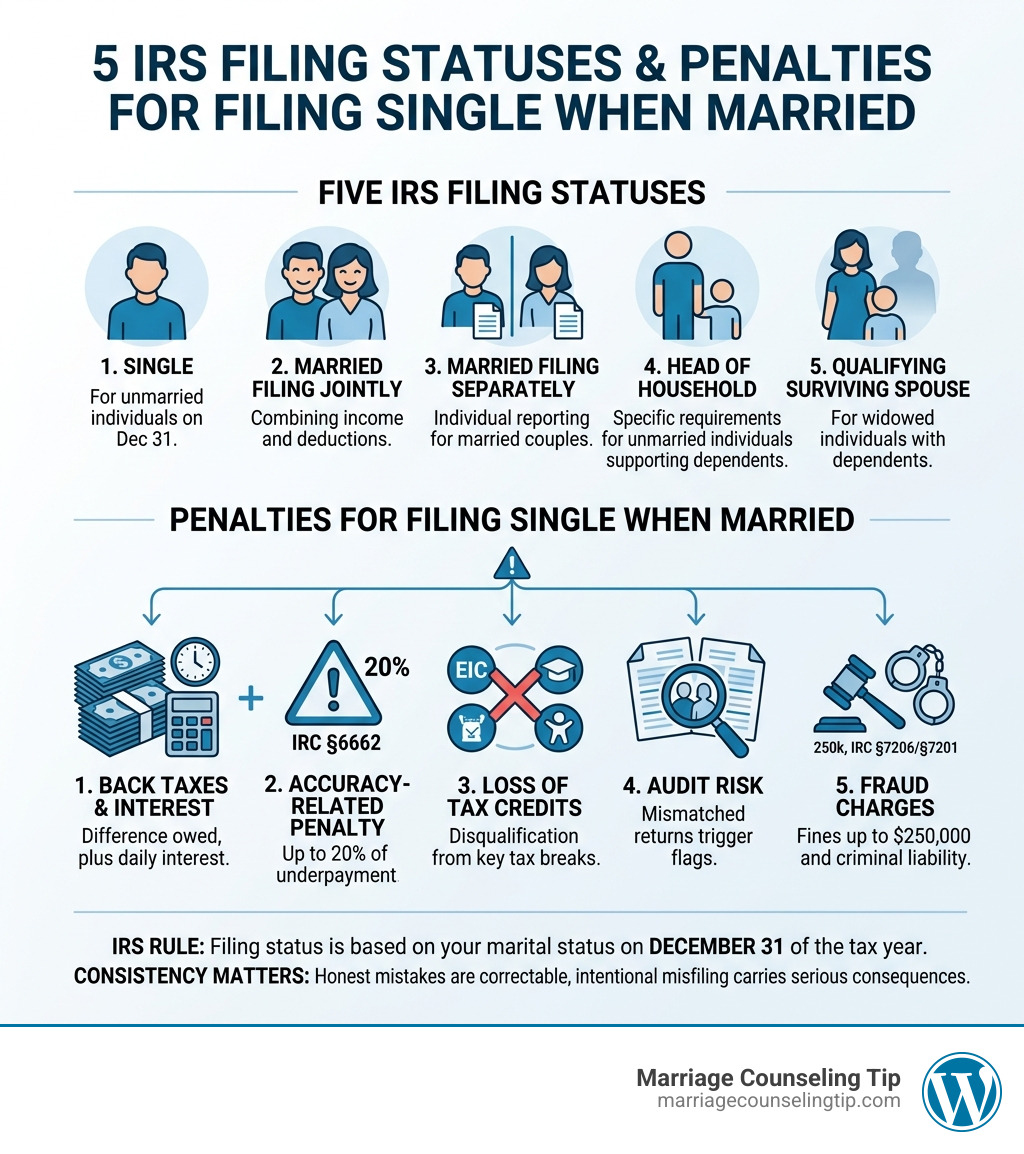
Here’s a fast summary of the key penalties:
| Penalty Type | Details |
|---|---|
| Back taxes + interest | You owe the difference between what you paid and what you should have paid, plus daily interest |
| Accuracy-related penalty | Up to 20% of the underpaid amount under IRC §6662, if underpayment exceeds 10% of taxes owed or $5,000 |
| Loss of tax credits | You may lose the Earned Income Credit, education credits, Child and Dependent Care Credit, and more |
| Audit risk | Mismatched returns between spouses trigger IRS flags |
| Fraud charges (intentional) | Fines up to $250,000 and potential criminal liability under IRC §7206 or §7201 |
The IRS determines your filing status based on your marital status on December 31 of the tax year. If you were legally married on that date, filing as “Single” is simply not allowed — no matter how long you lived apart or how separate your finances were.
Honest mistakes are correctable. But intentional misfiling is a different story entirely.
This matters deeply if you’re in a marriage where your spouse has tax debt, hidden finances, or has filed without your knowledge. The wrong filing status — even one chosen by your accountant — can expose you to serious financial and legal consequences.
IRS Rules for Marital Filing Status
When it comes to the IRS, your marital status isn’t a “vibe” or a feeling—it is a legal fact determined by the calendar. The most important date for your tax return is December 31. If you are legally married on that final day of the year, the IRS considers you married for the entire year.
We often talk to couples who believe that because they lived in separate houses or didn’t share a bank account, they could simply check the “Single” box. Unfortunately, the tax code doesn’t work that way. More info about tax filing requirements for couples shows that you generally have only two choices: Married Filing Jointly (MFJ) or Married Filing Separately (MFS).
There are very narrow exceptions. You might be “considered unmarried” for tax purposes if you meet the strict criteria for Head of Household (HOH). This usually requires living apart from your spouse for the last six months of the year, providing a home for a qualifying dependent, and paying more than half the cost of keeping up that home. However, even in these cases, you are not filing as “Single”—you are filing as Head of Household.
If you are in the middle of a divorce, you are still “married” until a judge signs that final decree of divorce or separate maintenance. A simple “trial separation” or a “break” does not change your status. For those who want to keep their finances entirely isolated, the IRS guidance on Married Filing Separately provides the only legal path to file an individual return while remaining legally wed.
What is the Penalty for Filing Single When Married?

If you have already hit “send” on a return marked “Single” while you were legally married, you might be wondering how the IRS would even find out. The truth is, the IRS has become incredibly efficient at data matching. They cross-reference Social Security Administration (SSA) records, name change databases, and even your spouse’s tax return. If your spouse files as “Married” and you file as “Single,” a red flag is instantly waved in the IRS system.
So, what is the penalty for filing single when married? It starts with the money. When you file under the wrong status, the IRS will likely “recalculate” your return. Because the Single status often allows for credits and deductions that married people aren’t entitled to (or have different income thresholds for), you will likely end up owing back taxes.
The IRS doesn’t just ask for the missing money; they add interest that accrues daily from the original due date of the return. This can turn a small mistake into a mountain of debt very quickly. Furthermore, an incorrect filing status is one of the most common rules and penalties for filing single while married that triggers a full-blown audit, where the IRS may begin digging into every other part of your financial life.
Financial Consequences and What is the Penalty for Filing Single When Married?
The financial sting goes deeper than just back taxes and interest. Under Internal Revenue Code (IRC) §6662, the IRS can hit you with an “accuracy-related penalty.” This is typically 20% of the underpaid tax amount.
This penalty usually applies if the underpayment is “substantial.” For individuals, that means the underpayment exceeds 10% of the tax required to be shown on the return or $5,000, whichever is greater. As we look toward the 2026 tax season, these thresholds remain a critical boundary for taxpayers.
When you lose your “Single” status and are forced into “Married Filing Separately” status, you might also find yourself in a higher tax bracket than you expected. More info about tax brackets for married couples explains how the brackets for MFS are much narrower than for joint filers. For example, in 2025 and 2026, the top 37% bracket for married couples filing separately starts at half the income level of joint filers. By filing Single, you may have “stolen” a lower tax rate that you weren’t entitled to, and the IRS will claw that difference back with interest.
Legal Risks: Understanding What is the Penalty for Filing Single When Married for Fraud
While most filing status errors are honest mistakes or bad advice from a cut-rate tax preparer, the IRS draws a sharp line at “willful” misrepresentation. If the IRS believes you intentionally checked the “Single” box to lower your tax bill or hide income, you could face criminal charges for tax fraud or tax evasion under IRC §7206 or §7201.
The penalties for intentional fraud are staggering:
- Fines up to $250,000 for individuals.
- Potential prison time.
- A permanent criminal record.
Understanding Married Filing Separately restrictions is vital because many people choose the Single status specifically to claim the Earned Income Tax Credit (EITC) or education credits that are strictly forbidden for married couples filing separately. If the IRS sees that you filed as Single specifically to pocket these credits, they are much more likely to view it as a fraudulent act rather than a simple oversight.
Married Filing Separately vs. Single Status
Many people confuse “Single” and “Married Filing Separately” because the standard deduction amounts often look the same. For the 2025 tax year, the standard deduction for both Single and MFS is $15,750 (rising slightly for 2026). However, that is where the similarities end.
| Feature | Single Status | Married Filing Separately (MFS) |
|---|---|---|
| Standard Deduction (2025) | $15,750 | $15,750 |
| Education Credits | Available | Disallowed |
| Earned Income Credit | Available | Disallowed (usually) |
| Itemized Deductions | Independent | Must match spouse (if one itemizes, both must) |
| Student Loan Interest | Deductible | Disallowed |
| IRA Contributions | Standard limits | Highly restricted phase-outs ($0-$10,000) |
As you can see, MFS is significantly more restrictive. More info about choosing the best filing status highlights that MFS is often the most expensive way to file.
If you live in a community property state (like California, Texas, or Arizona), the rules get even more complex. In these states, you can’t just report “your” income. You generally must split all community income 50/50 with your spouse, even if you file separately. If you filed as Single, you likely reported 100% of your own income and 0% of your spouse’s, which is a major violation of community property tax laws.
How to Correct a Filing Status Error
If you’ve realized you made a mistake, don’t panic—but do act quickly. The longer you wait, the more interest the IRS will tack on. The primary tool for fixing this is Form 1040-X, Amended U.S. Individual Income Tax Return.
Generally, you have a three-year window from the date you filed your original return (or two years from the date you paid the tax, whichever is later) to file an amendment.
Sometimes, the error isn’t even yours. We have seen cases where an accountant filed a client as single because it was “easier” or because they didn’t realize the client had married during the year. If this happened to you, you should request your IRS transcripts to see exactly what was submitted. More info about filing separately when a spouse owes debt can be helpful if you are amending your status because you discovered your spouse has secret tax liabilities.

When you file the 1040-X, you will need to:
- Check the box for the correct filing status (MFJ or MFS).
- Recalculate your tax liability, deductions, and credits.
- Include a clear explanation of why you are amending (e.g., “Original return incorrectly filed as Single; changing to Married Filing Separately to reflect legal marital status”).
- Pay any additional tax owed immediately to stop the interest clock.
If the resulting bill is too large to pay at once, the IRS offers payment plans and installment agreements to help you manage the debt without facing immediate levies or liens.
Frequently Asked Questions about Filing Status
Can I file single if I am legally separated?
You can only file as Single if you have a final decree of divorce or separate maintenance by December 31. If you are just “living apart” or have a preliminary “legal separation” agreement that hasn’t been finalized by a court, the IRS still considers you married. In some cases, if you live apart and have a dependent, you might qualify for Head of Household, but you still cannot file as Single.
What happens if my accountant filed me as single by mistake?
You are ultimately responsible for the information on your tax return, even if a professional prepared it. If your accountant made a mistake, you must file an amended return (Form 1040-X) to fix it. You may be able to seek “penalty abatement” from the IRS by showing you had “reasonable cause” (relying on a professional), but you will still owe the back taxes and interest. You might also consider a malpractice claim against the preparer if their negligence caused you significant financial harm.
Does the IRS check my marital status with the Social Security Administration?
Yes, absolutely. The IRS and the SSA share a robust data-matching system. If you get married and change your name with the SSA, or if your spouse lists you on their health insurance or other federal forms, the IRS will eventually catch the discrepancy. Mismatched filing statuses between spouses are one of the easiest “low-hanging fruit” triggers for an automated IRS notice.
Conclusion
At Marriage Counseling Tip, we understand that taxes are rarely just about the math. They are about trust, partnership, and sometimes, the painful discovery of financial infidelity. When one spouse hides tax debt or files incorrectly without the other’s knowledge, it can feel like the foundation of the marriage is crumbling.
The penalty for filing single when married can be a heavy burden, but it doesn’t have to be the end of your financial security or your relationship. By understanding your options—like Innocent Spouse Relief—you can protect yourself from a partner’s past mistakes or fraudulent filings. We specialize in helping couples navigate the psychological and financial intersection of tax debt.
Whether you are looking for strategies to survive IRS debt or need advice on how to handle the emotional fallout of a tax audit, there is a path forward. More info about surviving tax debt and marriage is available to help you protect your future, separate your liabilities, and find peace of mind in the face of IRS enforcement. Don’t let a filing error define your future; take the steps today to correct the record and safeguard your finances.