
Surviving the Secret Spend: A Guide to Recovery
When Money Becomes a Secret: Understanding Financial Infidelity in Marriage
How to deal with financial infidelity starts with these core steps:
- Stay calm — Avoid reacting in the heat of the moment
- Gather evidence — Pull credit reports, bank statements, and financial records
- Have an honest conversation — Approach your partner with specific facts, not accusations
- Assess the damage — Understand the full scope of hidden debt or accounts
- Protect yourself — Set up individual accounts and consult a legal or financial professional
- Rebuild together (or separately) — Decide whether to pursue counseling, a repayment plan, or legal separation
Finding out your spouse has been hiding money, debt, or secret accounts can feel like the ground shifting under your feet. It’s not just about the dollars. It’s about trust — and the quiet fear that the person you built a life with has been working against you.
More than 40% of couples who share finances admit to hiding purchases, lying about debt, or concealing accounts. And 85% of those who committed financial deception say it damaged their relationship in some meaningful way.
If your spouse has hidden IRS back taxes, secret debt, or undisclosed accounts, you may be wondering whether you’re now on the hook for money you never spent. That fear is valid — and it’s exactly why understanding your options matters so much.
This guide walks you through every stage: recognizing the signs, confronting the problem, protecting yourself, and deciding what comes next.
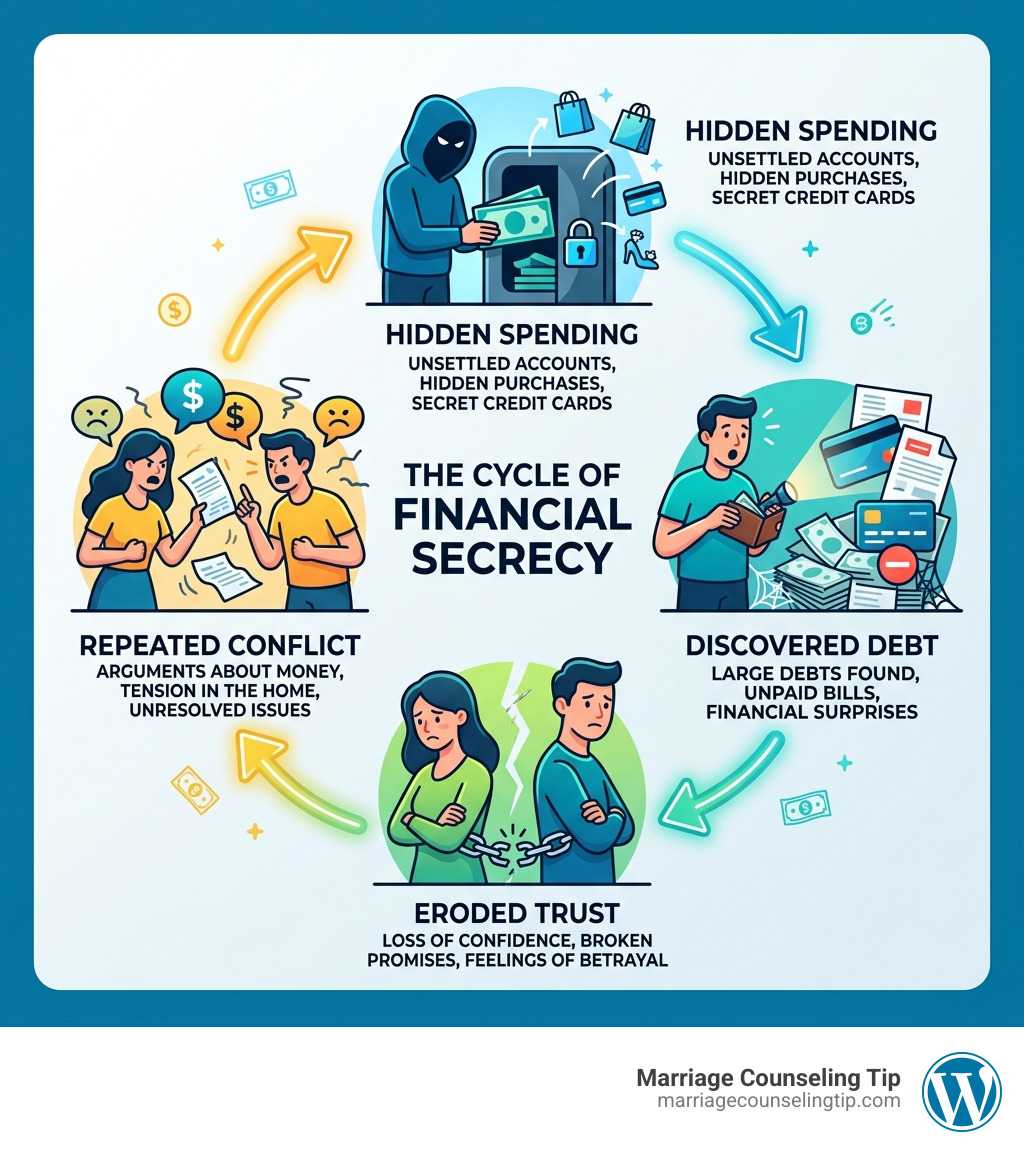
How to deal with financial infidelity terms explained:
The Psychology and Prevalence of Financial Betrayal
Financial infidelity occurs when one partner in a relationship intentionally hides, lies about, or manipulates financial information. It isn’t just about a forgotten coffee receipt; it’s a conscious choice to keep a spouse in the dark about significant money behaviors. According to Financial Infidelity: What It Is and How to Recover, this can range from hiding a “boatload of debt” to maintaining secret bank accounts or lying about income to divert cash.
The root causes of this behavior are rarely about the money itself. Often, it is a “bad solution” to a deeper problem. Some people hide spending because of a deep fear of conflict—they would rather lie than face a lecture. Others may be struggling with shame or addiction, such as gambling, compulsive shopping, or substance abuse. Sometimes, it’s a power dynamic issue where one partner feels they lack autonomy and “acts out” by spending in secret. As noted in How to Stop Financial Infidelity, money is one of the most insidious power issues because it can go underground so easily.
How Common is Financial Infidelity in Relationships?
If you feel alone in this, the statistics suggest otherwise. Research shows that 43% of adults who have combined their resources confess to committing some act of financial deception. Furthermore, 75% of adults report that financial deceit has impacted their relationship in some way.
It starts small but scales quickly. Roughly one in three married people admit to hiding a purchase from their spouse, and 31% of couples have a credit card that their partner knows nothing about. These secrets act like termites in the foundation of a marriage; you might not see them at first, but they are slowly hollowing out the structural integrity of your partnership.

Recognizing the Red Flags of Financial Infidelity
Often, the gut feeling that something is “off” precedes the actual discovery. Common red flags include:
- Missing Mail: You notice that bank statements or credit card bills that used to arrive regularly have suddenly stopped.
- Defensiveness: A simple question like “How are the savings looking?” triggers an angry or evasive response.
- Unexplained Purchases: New clothes, gadgets, or even vehicle upgrades appear without any discussion of where the money came from.
- Secretive Phone Behavior: Your partner becomes overly protective of their phone or computer, especially when looking at banking apps.
- Sudden Cash Withdrawals: Large amounts of cash leaving joint accounts with no clear purpose.
- Intercepted Bills: Your partner insists on being the only one to check the mail or manages all the passwords with no transparency.
How to Deal with Financial Infidelity: Immediate Steps
When the truth finally comes out—whether you find a hidden bill or your partner confesses—the initial shock can be paralyzing. The most important thing we can tell you is to stay calm. Reacting in the heat of the moment often leads to more defensiveness and less information.
Your next move is to gather evidence. Before the “paper trail” disappears, pull your credit reports and download bank statements. You need to see the “math” behind the betrayal to understand the scope of the damage. According to How to Deal with Financial Infidelity: Next Steps and Solutions, taking a breath and gathering facts allows you to handle the situation effectively rather than just emotionally.
If there is any risk of financial retaliation or domestic violence, prioritize your safety first. This may mean setting up an individual account at a different bank and changing your digital passwords immediately.

Confronting Your Partner About Suspected Financial Infidelity
Confrontation doesn’t have to be a “blow-up.” In fact, experts suggest a neutral questioning approach. Instead of saying, “I know you’re lying about the credit card,” try: “I saw something on our statement that I don’t understand. Can you help me walk through these charges?”
This preserves their dignity and creates a “doorway” for them to be honest. Avoid what psychologists call the “Four Horsemen”—criticism, contempt, defensiveness, and stonewalling. Focus on the motive: Why did they feel they couldn’t tell you? Was it fear, shame, or a sense of entitlement? Understanding the “why” is the only way to prevent a “next time.”
Protecting Yourself from Shared Financial Liabilities
One of the scariest parts of how to deal with financial infidelity is the legal reality: in many cases, you are responsible for your spouse’s secrets. If you have joint accounts, you are likely “jointly and severally” liable for the debt. This is especially true with IRS back taxes. If you signed a joint tax return, the IRS generally views you as equally responsible for the debt, even if your spouse was the one hiding income.
| Feature | Financial Infidelity | Financial Irresponsibility |
|---|---|---|
| Intent | Deliberate secrecy and lying | Forgetfulness or poor habits |
| Awareness | Knows partner would disapprove | May not realize the impact |
| Action | Hiding bills, secret accounts | Forgetting to log a lunch expense |
| Impact | Destroys foundational trust | Causes minor budget friction |
In states like California, spouses owe each other a fiduciary duty—the highest duty of good faith and fair dealing. If a spouse violates this by hiding assets or racking up secret debt, a forensic accountant or legal counsel may be needed to protect your share of the marital estate.
Rebuilding Trust and Creating Financial Transparency
Can a relationship survive this? Yes, but it requires radical honesty. The partner who committed the infidelity must be willing to make a full disclosure. “Partial confessions” are toxic—finding out about a second secret a month after the first one is often what finally ends the marriage.
As suggested in Caught Hiding Money? Experts Reveal How Couples Can Rebuild Trust, you should establish monthly money dates. These are not meant to be interrogations, but scheduled times to review the budget, check progress on goals, and ensure both partners have eyes on every account.
Practical Strategies to Prevent Financial Infidelity in the Future
To move forward, you need a system that makes secrecy difficult and transparency easy.
- The Three-Account Structure: We often recommend a “Yours, Mine, and Ours” approach. Each partner gets a small, agreed-upon amount of “no-questions-asked” money in a separate account, while the bulk of the income goes into a joint account for household needs. This fosters autonomy without secrecy.
- Zero-Based Budgeting: Use tools like EveryDollar to give every cent a name. When every dollar is accounted for, hidden spending becomes much harder to pull off.
- Spending Limits: Agree that any purchase over a certain amount (e.g., $100) requires a quick “check-in” text or conversation.
- Financial Literacy: Often, one partner handles the money because the other feels “bad at math.” We believe both partners must understand the basics. Shared responsibility is the best defense against betrayal.
The Role of Communication in Overcoming Financial Infidelity
Transparency is the “math” part of recovery; communication is the “heart” part. Rebuilding trust requires the betrayed partner to be vulnerable about their hurt and the perpetrator to be consistent in their actions. Trust isn’t rebuilt with a single grand gesture or a tearful apology; it’s rebuilt through boring consistency over months and years.
Legal Protections and Professional Intervention
Sometimes, the damage is too complex to handle alone. If your spouse has incurred massive debt or hidden significant assets, you may need a forensic accountant or a divorce attorney to untangle the web.
However, if you want to save the marriage, financial therapy or couples counseling is a must. A therapist can help you navigate the emotional fallout while a financial professional helps you restructure your debt. According to Financial Infidelity in Relationships: How to Recover, therapy provides a safe space to address the root causes—like addiction or childhood money trauma—that led to the secrecy.
When to Consider Professional Help
You should seek professional help immediately if:
- The deception is chronic or has happened multiple times.
- The “infidelity” is tied to an addiction (gambling, drugs, etc.).
- You cannot have a conversation about money without it devolving into a screaming match.
- There is complex tax debt, such as IRS back taxes, that threatens your home or wages.
Legal Safeguards During Divorce or Separation
If you decide that the trust is beyond repair, legal protections are your primary shield. In many jurisdictions, you can file for innocent spouse relief with the IRS. This is a specific legal strategy we specialize in at Marriage Counseling Tip. It allows you to be relieved of responsibility for paying tax, interest, and penalties if your spouse (or former spouse) improperly reported items or omitted items on your joint tax return without your knowledge.
Frequently Asked Questions about Financial Betrayal
Does financial infidelity always lead to divorce?
Not necessarily. While it is a strong predictor of divorce, many couples emerge from this crisis stronger. It requires both partners to be “all in” on a new era of transparency. If the perpetrator takes full responsibility and the betrayed partner is willing to eventually forgive, reconciliation is possible.
What is the difference between infidelity and irresponsibility?
Intent is the key. Financial irresponsibility is forgetting to mention you grabbed a burger for lunch or accidentally overdrawing an account because you didn’t check the balance. Financial infidelity is opening a secret credit card because you know your spouse would never approve of your spending. One is a mistake; the other is a lie.
Can a marriage really survive secret debt?
Yes, but it requires a concrete repayment plan. You have to treat the debt as an “us against the problem” scenario. This often involves cutting lifestyle costs, selling items, or working extra hours to clear the slate. The “secret” part of the debt is usually more damaging than the “debt” part itself.
Conclusion
At Marriage Counseling Tip, we understand that financial betrayal isn’t just a line item on a bank statement—it’s a wound to the heart of your marriage. Whether you are dealing with hidden credit cards or the crushing weight of IRS back taxes, you don’t have to navigate this alone.
We specialize in the intersection of tax debt relief and marital recovery. Our mission is to protect spouses from their partner’s liabilities through strategies like innocent spouse relief, while providing the psychological tools needed to rebuild a foundation of trust.
Recovery is a journey of a thousand small, honest conversations. If you’re ready to start that journey and protect your financial future, we are here to help.
Learn more about our marriage counseling and tax debt services