
When He Lies About Money: A Survival Guide
When Your Husband Lies About Money, It Changes Everything
Husband financial infidelity is when a spouse deliberately hides, lies about, or misrepresents financial information — and it’s more common than most people realize.
Quick answers if you’re dealing with this right now:
- What it looks like: Secret credit cards, hidden debt, undisclosed bank accounts, concealed gambling losses, or lying about income
- How common it is: More than 40% of couples who share finances admit to some form of financial deception
- What’s at stake: Your credit, your savings, your home — and potentially your liability for his IRS back taxes
- What you can do: Pull your credit report, consult a family law attorney, and look into Innocent Spouse Relief if tax debt is involved
- Can it be fixed? Yes — but only with full financial disclosure and, in most cases, professional help
Consider this: you’re sitting at the kitchen table, sorting through the mail, when an unfamiliar credit card statement falls out. The name on the account is your husband’s. The balance is $23,000. You had no idea it existed.
That moment — that stomach-dropping, world-tilting moment — is what financial infidelity feels like. And it’s not just about money.
Research shows that financial deception takes the same emotional toll as physical or sexual betrayal. It doesn’t just damage your bank account. It damages the foundation of your marriage.
The hard truth? You can’t function as a financial team — or any kind of team — when one partner is lying. And if his hidden debts include unpaid taxes, the consequences can reach far beyond hurt feelings. They can threaten your home, your credit, and your financial future.
This guide is written for you: the spouse who is scared, confused, and trying to figure out what to do next.
Discover more about husband financial infidelity:
Defining Husband Financial Infidelity: More Than Just a Secret Purchase
At its core, Financial infidelity is a breach of the “financial contract” of your marriage. It is the act of concealing financial transactions, debt, or assets from a partner. While many people think of it as just a hidden shopping bag in the closet, it often goes much deeper, involving secret bank accounts, undisclosed raises, or massive amounts of hidden debt.
In many jurisdictions, spouses owe each other a “fiduciary duty.” This is a legal term that means you have a duty of the highest good faith and fair dealing toward one another. When a husband intentionally lies about money, he isn’t just being “bad with cash”—he is violating a fundamental legal and moral obligation.
Many wives wonder, Is Hiding Money From Your Spouse Wrong/ or even Is It Ok To Hide Money From Your Spouse/. While everyone deserves some level of autonomy, the moment that “privacy” turns into “secrecy” that affects the family’s stability, it becomes infidelity.
The Difference Between Irresponsibility and Husband Financial Infidelity
It is important to distinguish between a husband who is simply disorganized and one who is being deceptive. We all forget to mention a small lunch purchase or lose a receipt once in a while. That is financial irresponsibility.
Husband financial infidelity, however, involves intentional deceit. It is the deliberate choice to hide behavior because he knows you would disapprove. Whether it is Lying To Your Spouse About How Much Money You Spent/ or opening a credit card in secret, the intent to keep you in the dark is what defines the betrayal. Often, this stems from a misplaced need for autonomy or a fear of being “controlled,” but the result is a breakdown of the marital team.
Why Men Hide Money: Shame, Control, and Conflict Avoidance
Why do husbands do this? According to Psychology Today Canada, the reasons are often deeply psychological.
- Shame and Embarrassment: He may have made a bad investment or overspent and feels he has failed as a “provider.”
- Conflict Avoidance: He knows a certain purchase or debt will start a fight, so he hides it to keep the peace—not realizing that the eventual discovery will cause a much larger explosion.
- Control and Power: In some cases, money is used as a tool for dominance. By keeping secrets, he maintains a level of control over the household that you cannot challenge because you don’t have the facts.
- Addiction: Hidden spending is frequently a symptom of other issues, such as gambling or substance abuse.
Red Flags: How to Spot Husband Financial Infidelity

If you suspect something is wrong, trust your gut. Financial secrets rarely stay small; they tend to grow until the weight of the debt or the complexity of the lies becomes impossible to manage.
Common red flags include:
- Extreme Defensiveness: He gets angry or “gaslights” you when you ask simple questions about the bank balance.
- Missing Mail: You notice that bank statements or credit card offers stop arriving, or he insists on being the only one to check the mailbox.
- Unexplained Withdrawals: Large amounts of cash leaving joint accounts with no clear purpose.
- New “Work” Accounts: He claims he needs a separate account for “business expenses” that you aren’t allowed to see.
To protect yourself, we recommend using account aggregators or checking your joint credit reports regularly. If you find something, you need to know Is Your Partner Hiding Debt Look For These Red Flags/ and what to do When Your Partner Cheats With A Credit Card/.
Common Forms of Deceit in Modern Marriages
It is easier than ever to hide money. Pacesetter Planning notes that paperless billing and online-only banks make it simple to keep a spouse in the dark.
We frequently see husbands engaging in:
- Secret Credit Cards: Applying for cards using a work address or digital statements.
- Gambling Losses: Using apps to bet on sports or play digital poker, often funded by small, frequent transfers that go unnoticed.
- Hidden Loans: Borrowing money from family members or “payday” lenders to cover up previous overspending.
- Undisclosed Raises or Bonuses: Funneling extra income into a private account rather than the family budget.
The High Cost of Secrets: Emotional and Legal Consequences
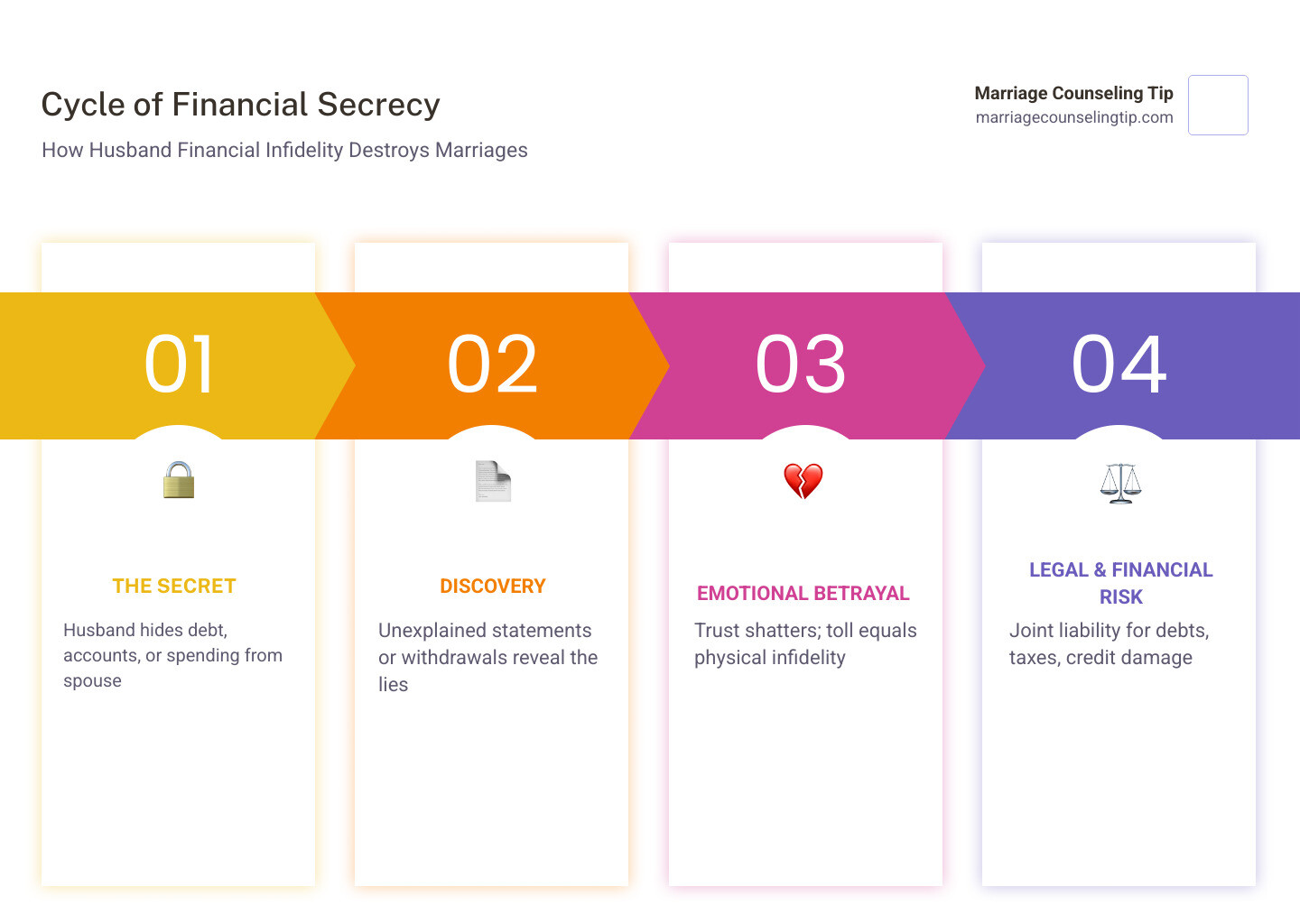
The impact of husband financial infidelity is twofold: it destroys the heart of the relationship and threatens the legal safety of the household.
Emotionally, the “betrayal trauma” is real. When you realize the person you trust most has been living a double life financially, it leads to anxiety, depression, and a loss of safety. In fact, many couples find that financial cheating is harder to move past than a physical affair because it directly impacts the family’s survival and future.
| Emotional Betrayal | Financial Liability |
|---|---|
| Loss of trust and intimacy | Damage to credit scores |
| Feelings of being “gaslit” or crazy | Legal responsibility for “marital debt” |
| Chronic stress and anxiety | Risk of losing the family home |
| Breakdown of communication | Potential IRS audits and penalties |
As noted by the Gottman Institute, these secrets put the entire relationship at risk. You may even find yourself asking Is Hiding Money From Your Spouse A Sin/ or Is Hiding Assets From Spouse Illegal/. The answer to the latter is often yes, especially during legal proceedings.
Impact on Divorce and Asset Division
If the infidelity leads to the end of the marriage, the “financial skeletons” will come out of the closet during the discovery process. Courts do not look kindly on spouses who hide assets or rack up “wasteful” debt (like gambling or spending on a paramour).
In these cases, you may need:
- Forensic Accounting: A specialist who can “follow the money” to find hidden accounts or offshore assets.
- Debt Allocation: Arguing that secret debts should be his sole responsibility rather than split 50/50.
- Discovery: Using legal tools like subpoenas to get records from banks he claimed didn’t exist.
Understanding the nuances of Splitting Assets After Financial Betrayal/ is crucial, as is knowing Is Hiding Money From Your Spouse Illegal/ in your specific state.
Protecting Your Future: Tax Debt and Legal Safeguards

One of the most terrifying forms of husband financial infidelity involves the IRS. If you file joint tax returns, you are generally “jointly and severally liable” for everything on that return—and everything left off of it.
If your husband has been hiding income or failing to pay payroll taxes for a business, the IRS can come after your wages and your bank accounts. This is where Tax Infidelity Recovery Tools And Guides To Survive The Secret Debt/ become essential.
Navigating the Discovery of Hidden Tax Liabilities
If you discover that your husband has left you with a mountain of IRS back taxes, do not panic. There are legal protections designed for spouses in your exact position.
- Innocent Spouse Relief: If you can prove you didn’t know (and had no reason to know) about the errors or omissions on the tax return, the IRS may release you from the debt.
- Separation of Liability: This allows you to allocate the tax debt between you and your (ex)spouse based on who actually earned the income.
- Equitable Relief: A “catch-all” for cases where it would simply be unfair to hold you responsible.
It is vital to seek Expert Advice On Finding The Right Counselor For Tax Infidelity/ to navigate these complex waters. As Investopedia points out, transparency is the only way forward, but legal safeguards are your safety net.
Rebuilding the Foundation: Recovery from Husband Financial Infidelity
Can a marriage survive this? Yes, but it requires a total “financial autopsy.”
The first step is Full Disclosure. He must bring every statement, every password, and every debt to the table. There can be no more “trickle-truth,” where he admits to $5,000 in debt today and another $5,000 next week.
We recommend:
- Weekly Money Meetings: A 20-minute check-in to review spending and progress.
- Therapy: Specifically Infidelity Therapy What To Expect In The First Month/ and Marriage Counseling For Infidelity A Step By Step Roadmap/.
- Online Support: Programs like Healing The Wallet Online Counseling For Financial Secrets/ can provide a safe space to process the betrayal.
Steps to Restore Financial Teamwork
Once the secrets are out, you need a system that makes it impossible for them to return.
- Zero-Based Budgeting: Every dollar has a name and a purpose. This isn’t about restriction; it’s about visibility.
- Accountability Systems: Using apps where both spouses see every transaction in real-time.
- Shared Goals: Realigning on what you are saving for—whether it’s a home, retirement, or just peace of mind.
For a detailed plan, see our Surviving The Secret Spend A Guide To Recovery/.
Frequently Asked Questions about Husband Financial Infidelity
Is hiding money from your spouse a crime?
While “lying” isn’t always a criminal act, Is Hiding Money From Your Spouse A Crime/ depends on the context. If he is hiding assets during a divorce or committing tax fraud, he could face significant legal ramifications, including contempt of court or criminal tax evasion charges.
How common is financial infidelity among husbands?
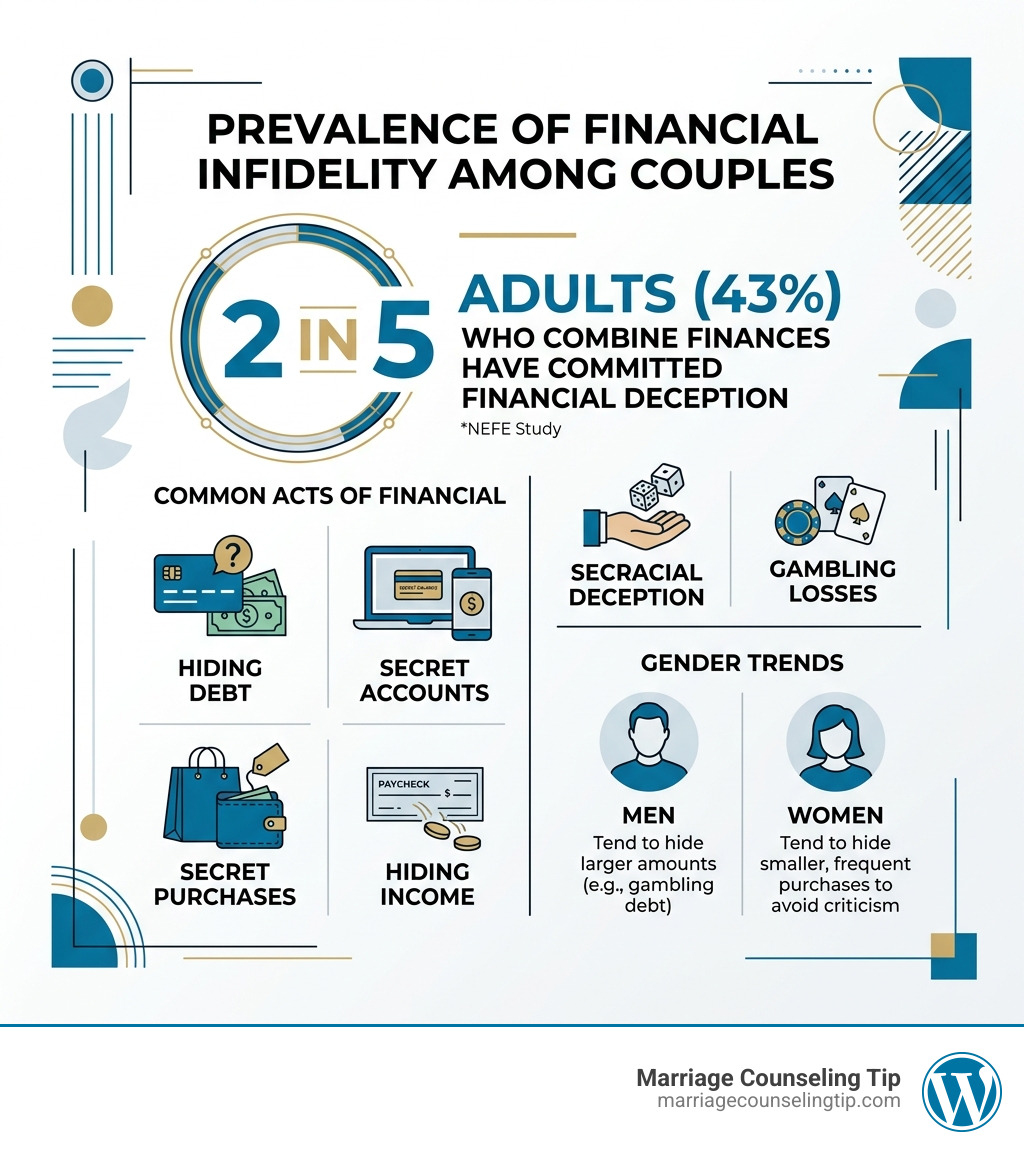
It is incredibly common. Studies from the NEFE suggest that 2 in 5 adults (43%) who have combined finances have committed some act of financial deception. While both genders engage in it, men are statistically more likely to hide larger amounts of debt or gambling losses, whereas women may hide smaller, frequent purchases to avoid criticism.
Can a marriage survive financial betrayal?
Yes, but it is a long road. Rebuilding trust takes time—often years. It requires the husband to be 100% transparent and the wife to be willing to engage in the difficult work of forgiveness and boundary-setting. Professional intervention from both a therapist and a financial advisor is often the “secret sauce” for success.
Conclusion
At Marriage Counseling Tip, we know that discovering husband financial infidelity feels like the end of the world. But it can also be the beginning of a much more honest, transparent, and secure chapter of your life. Whether you choose to rebuild your marriage or protect yourself through separation, you deserve to have the full picture of your financial life.
From navigating IRS back taxes to finding the right therapist, we are here to help you move from betrayal to bravery. Protect your future and your marriage by taking the first step toward transparency today.