
Tax Infidelity Recovery: Tools and Guides to Survive the Secret Debt
When Your Spouse’s Tax Secrets Become Your Problem
A tax infidelity recovery guide is a step-by-step resource for married people who have discovered their spouse hid income, ran up secret debt, or cheated on a joint tax return — leaving them exposed to IRS collection, penalties, and financial chaos they never saw coming.
If that’s where you are right now, here’s what you need to know fast:
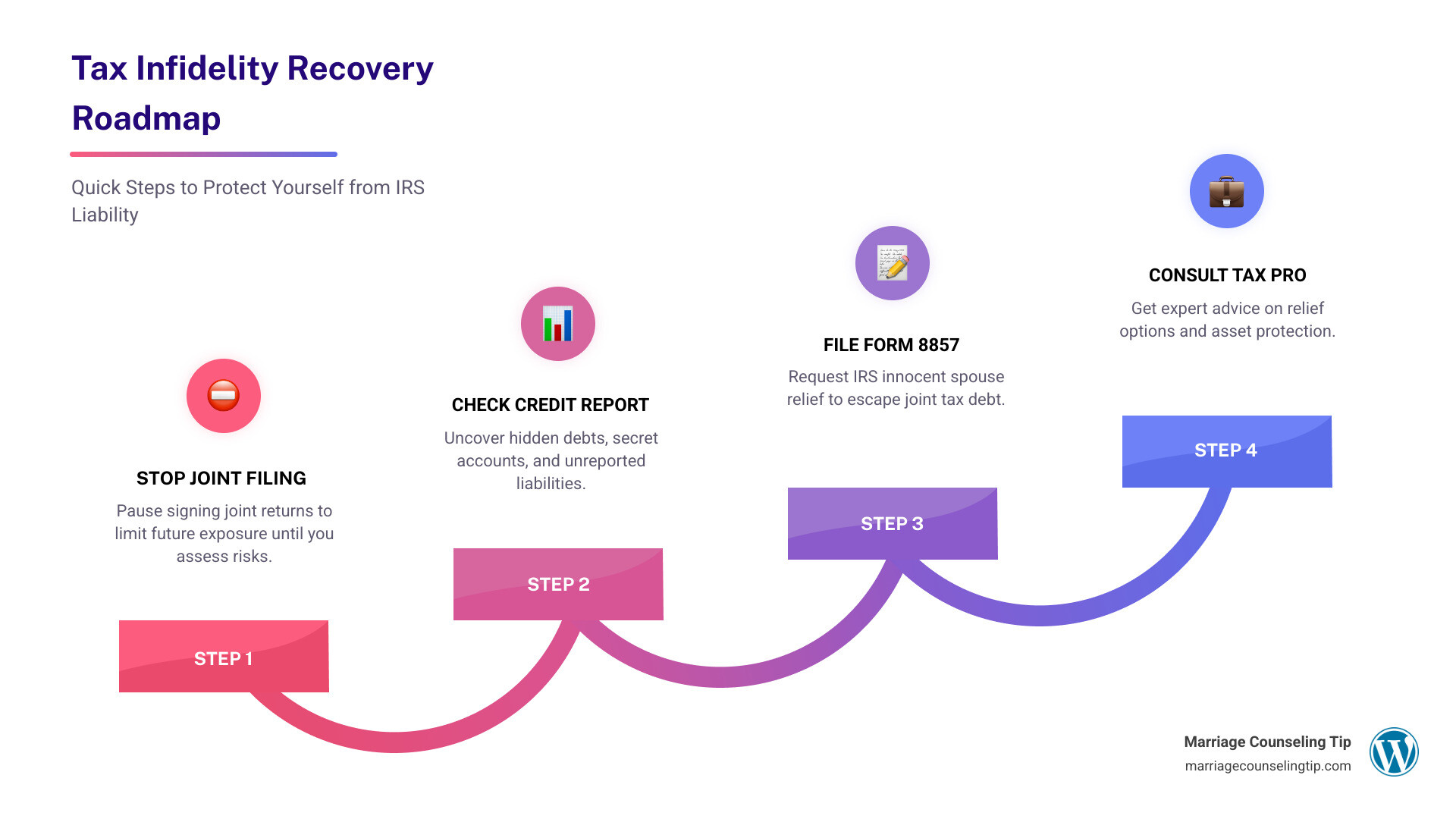
Your quick-start recovery steps:
- Stop filing jointly until you understand your exposure
- Pull your credit report to find hidden accounts or debt
- File Form 8857 to request innocent spouse relief from the IRS
- Consult a tax attorney or CPA who handles marital tax issues
- Separate your finances to protect assets going forward
- Seek couples counseling or a financial therapist to address the trust damage
This kind of betrayal hits twice. First, there’s the emotional shock of realizing your spouse was hiding something serious. Then comes the financial reality: under U.S. tax law, both spouses who sign a joint return are fully responsible for everything on it — even if only one of them knew the truth.
That means the IRS can come after your wages, your bank account, or even your home for taxes your spouse didn’t pay.
You didn’t cause this. But you still have to deal with it.
The good news? You have real options. Legal protections exist. Trust can be rebuilt. And many couples do come out the other side stronger — both financially and in their marriage.
This guide walks you through all of it.
Easy tax infidelity recovery guide glossary:
Understanding Tax Infidelity and Its Impact on Marriage

To understand tax infidelity, we first have to look at its parent category: financial infidelity. Financial infidelity occurs when one partner intentionally lies about, hides, or misuses money in a way that affects the relationship. Tax infidelity is a specific, high-stakes version of this. It involves hiding income from the IRS, claiming fraudulent deductions, or failing to pay tax liabilities while filing a joint return.
The stakes are higher here because of joint and several liability. When we sign that joint tax return, we are telling the government that we are both 100% responsible for the accuracy of the numbers and the payment of the debt. If your spouse hides $50,000 in side-hustle income, the IRS doesn’t care that you didn’t see a dime of it; they can legally seize your paycheck to cover the bill.
The impact on a marriage is often devastating. Statistics show that 41% of married couples say fighting about money is almost inevitable. Furthermore, one in three people admit to hiding purchases from their spouse, and 31% of couples have a credit card their partner knows nothing about. When these “small” secrets escalate into tax evasion, the betrayal feels akin to a physical affair. It’s not just about the math; it’s about the broken promise of partnership.
As noted in What to do if a Spouse Cheats on Taxes, even a divorce decree stating your ex is responsible for the debt won’t stop the IRS from coming after you. The government wasn’t a party to your divorce, so they aren’t bound by your settlement.
| Feature | Financial Irresponsibility | Financial Infidelity |
|---|---|---|
| Intent | Forgetfulness or poor habits | Intentional deception/hiding |
| Example | Forgetting to mention a lunch out | Opening a secret credit card |
| Tax Impact | Missing a receipt | Hiding income or falsifying data |
| Trust Level | Strained but transparent | Severely broken |
The Tax Infidelity Recovery Guide: Immediate Steps After Discovery

If you’ve just found a “Notice of Intent to Levy” or discovered a stack of unopened IRS envelopes in your spouse’s car, your heart is likely racing. This is the moment to move from panic to “detective mode.”
The first step in any tax infidelity recovery guide is to gather the facts. You need to scrutinize your joint income tax returns for the last several years. Look for red flags such as:
- Missing W-2s or 1099s: Does the income on the return match the lifestyle you’re living?
- Unexplained Deductions: Are there massive “business expenses” for a business that doesn’t seem to do much?
- Lifestyle Discrepancies: If your spouse claims to earn $40,000 but you’re vacationing like you make $200,000, the IRS will eventually notice the gap.
Perform a “lifestyle audit” on your own household. Check your credit reports at all three major bureaus to see if there are loans or credit cards in your name (or joint names) that you didn’t authorize. This often reveals the “why” behind tax cheating—spending addictions, gambling, or even secret second lives.
Once you have evidence, do not confront your spouse in a vacuum of information. Consult a professional. Whether it’s a tax attorney, a CPA, or a specialized counselor, you need an objective third party to help you navigate the legalities. For many, the most critical tool will be Innocent spouse relief | Internal Revenue Service, which provides a potential path to legal “absolution” from your spouse’s errors.
How can a tax infidelity recovery guide help with IRS debt?
A structured recovery guide helps you navigate Form 8857, the official Request for Innocent Spouse Relief. This isn’t just a form; it’s a legal argument. You must prove that when you signed the return, you didn’t know—and had no reason to know—that there was an understatement of tax.
IRS Publication 971 outlines the three types of relief:
- Innocent Spouse Relief: For when your spouse didn’t report income or claimed improper deductions.
- Separation of Liability: Which allocates the tax debt between you and your spouse based on who actually earned the income.
- Equitable Relief: A “catch-all” for when it would simply be unfair to hold you liable, often used in cases involving domestic abuse or where the spouse had no access to the funds.
Identifying signs of tax infidelity on a joint return
Scrutinizing a tax return requires a keen eye. Look for “Schedule C” losses that seem inflated. If your spouse has a hobby they call a “business,” they might be using it to write off personal expenses (like that new boat or high-end dinners). Another red flag is a sudden change in filing status or a refusal to let you see the return before you sign it. If your spouse says, “Just sign here, I’ve handled everything,” that is a signal to stop and read every line.
Legal Protections: Navigating IRS Relief Options
Navigating the IRS is intimidating, but the law provides specific exits for the “innocent” party. Understanding these options is the core of any tax infidelity recovery guide.
- Innocent Spouse Relief: This is the most common path. To qualify, you must show that at the time of signing, you were unaware of the errors and that, considering all facts and circumstances, it would be unfair to hold you liable.
- Injured Spouse Relief: This is different. This applies if your portion of a joint tax refund was seized to pay your spouse’s past debts (like child support or student loans from before you were married).
- The Two-Year Window: Generally, you must file for relief within two years of the date the IRS first tried to collect the tax from you. Waiting can be a million-dollar mistake.
For those who have suffered from domestic violence or coercive control, the IRS has expanded protections. If you were forced to sign a return under duress, the IRS may treat that return as invalid for you, effectively shielding you from the liability. You can find more technical details in More info about IRS Publication 971.
Rebuilding Trust and Financial Transparency
Once the legal fires are being managed, the emotional ones need attention. Can a marriage survive this? Yes, but it requires “Radical Honesty.”
We often recommend the Gottman Trust Revival Method. This involves three phases: Atonement, Attunement, and Attachment.
- Atonement: The spouse who cheated must hear the pain they caused without getting defensive. They must confess everything—no “partial confessions” that act as time bombs for later.
- Attunement: We help couples learn to discuss money without it turning into a war. This involves regular “money dates.”
- Attachment: Rebuilding a new “Marriage 2.0” where transparency is the default.
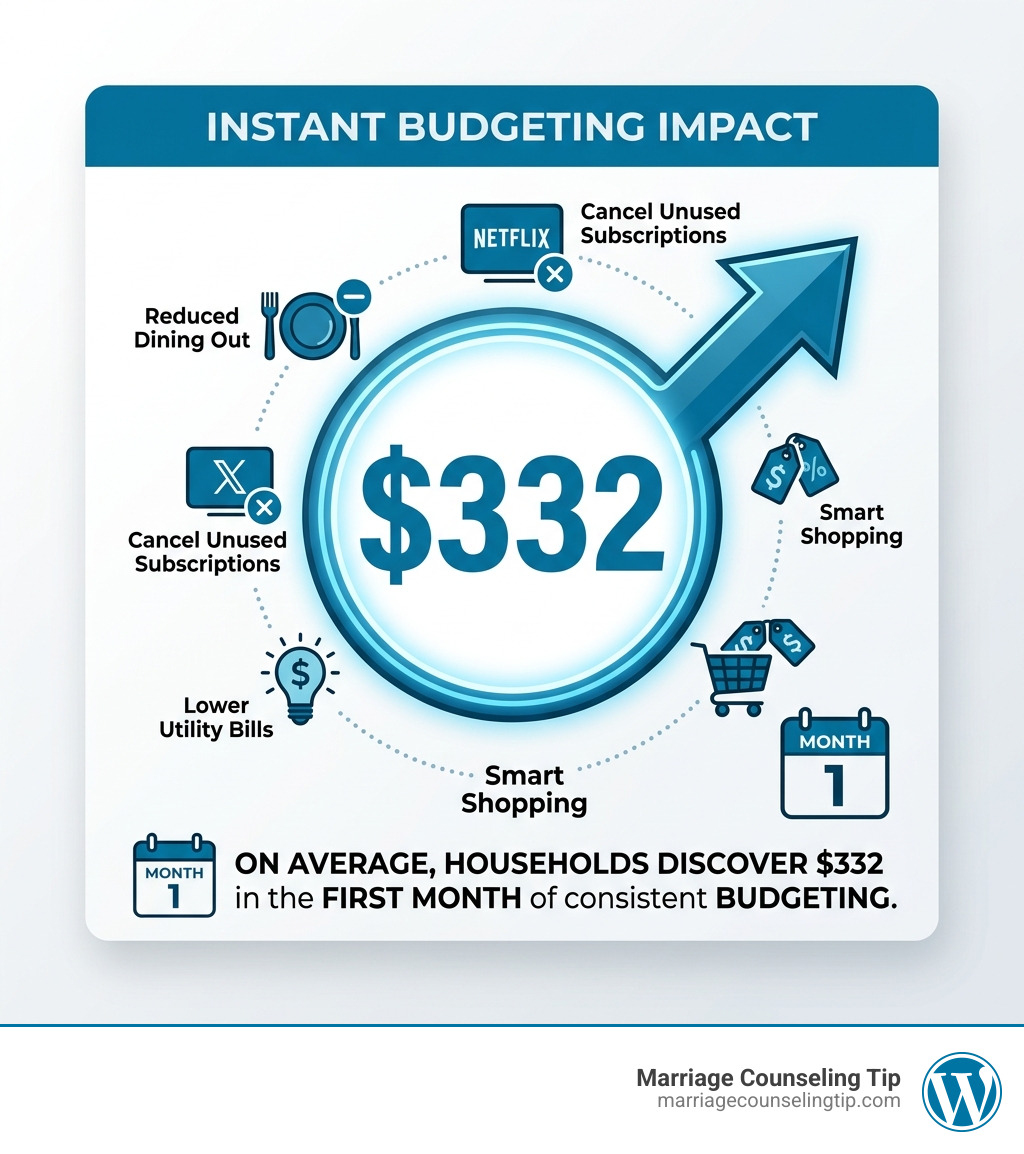
Practical tools are essential. We suggest using a zero-based budgeting tool like EveryDollar. When every dollar has a name and a destination, there is no room for “ghost” money to disappear into secret accounts. Both spouses must have full login access to all bank accounts, credit card portals, and tax filing software. As we discuss in 5 Ways to Rebuild After Financial Infidelity, rebuilding trust is a slow process of consistent, “boring” honesty.
Long-term strategies for your tax infidelity recovery guide
Recovery isn’t a one-time event; it’s a lifestyle change. Long-term success involves:
- Shared Financial Goals: Instead of hiding money from each other, start saving for something together.
- Professional Marriage Coaching: Sometimes a neutral third party is needed to navigate the “triggers” that come up during tax season.
- The “Picture Rule”: Some couples find success by texting a photo of any purchase over a certain limit (e.g., $100) to their spouse. It’s not about asking permission; it’s about maintaining visibility.
- Ongoing Accountability: For more on the psychological side of this, see Financial Infidelity in Relationships: How to Recover.
Frequently Asked Questions about Tax Infidelity
Is tax infidelity a crime?
Tax infidelity itself is a relational term, but the actions behind it are often criminal. Falsifying a tax return is tax fraud, which can carry prison time and massive civil penalties. If your spouse is diverting company funds to hide income, that could be embezzlement. While the IRS rarely jails the “innocent” spouse, they will certainly take your assets. In extreme cases, if the IRS suspects intentional evasion, they may refer the case to the Department of Justice for criminal prosecution.
Should I file jointly or separately after discovering tax infidelity?
This is a critical decision in your tax infidelity recovery guide. Filing as Married Filing Separately (MFS) is often the safest move after discovery. While it usually results in a higher total tax bill (you lose many credits and deductions), it creates a “firewall” between you and your spouse’s tax liability. You are only responsible for what is on your return. If you are in the middle of a divorce, MFS is almost always the recommended path to prevent your ex from dragging you into new IRS troubles.
Can a marriage survive tax-related financial betrayal?
It can, but only if the “cheater” is willing to give up all financial privacy. Trust is a gift that was broken; it must be earned back through years of transparency. Many couples find that after the “1.0” version of their marriage died in the tax crisis, they were able to build a “2.0” version that was actually more intimate because there were no more secrets. However, if the spouse continues to hide accounts or refuses to seek help for underlying issues like gambling or shopping addictions, the marriage may not be salvageable.
Conclusion
At Marriage Counseling Tip, we’ve seen that tax infidelity doesn’t have to be the end of your story. It is a crisis, yes, but it’s also a crossroads. By using this tax infidelity recovery guide, you are taking the first steps toward empowerment. You are moving from being a victim of “joint and several liability” to being an informed partner who knows their rights.
Whether you choose to rebuild your marriage or protect yourself as you move toward a new life, you have the right to financial safety. You deserve a partnership where the “fine print” doesn’t contain secrets that could ruin your future.
Start your recovery journey today by exploring our deep-dive resources on innocent spouse relief and marital financial healing. You’ve survived the discovery; now, let’s survive the recovery.