
Standard Deduction for Married Filing Jointly 101
What Is the Standard Deduction for Married Filing Jointly — Quick Answer
What is the standard deduction for married filing jointly is one of the most searched tax questions among married couples — and for good reason. The number directly affects how much of your income gets taxed.
Here’s the fast answer:
| Tax Year | Standard Deduction (Married Filing Jointly) |
|---|---|
| 2025 | $31,500 |
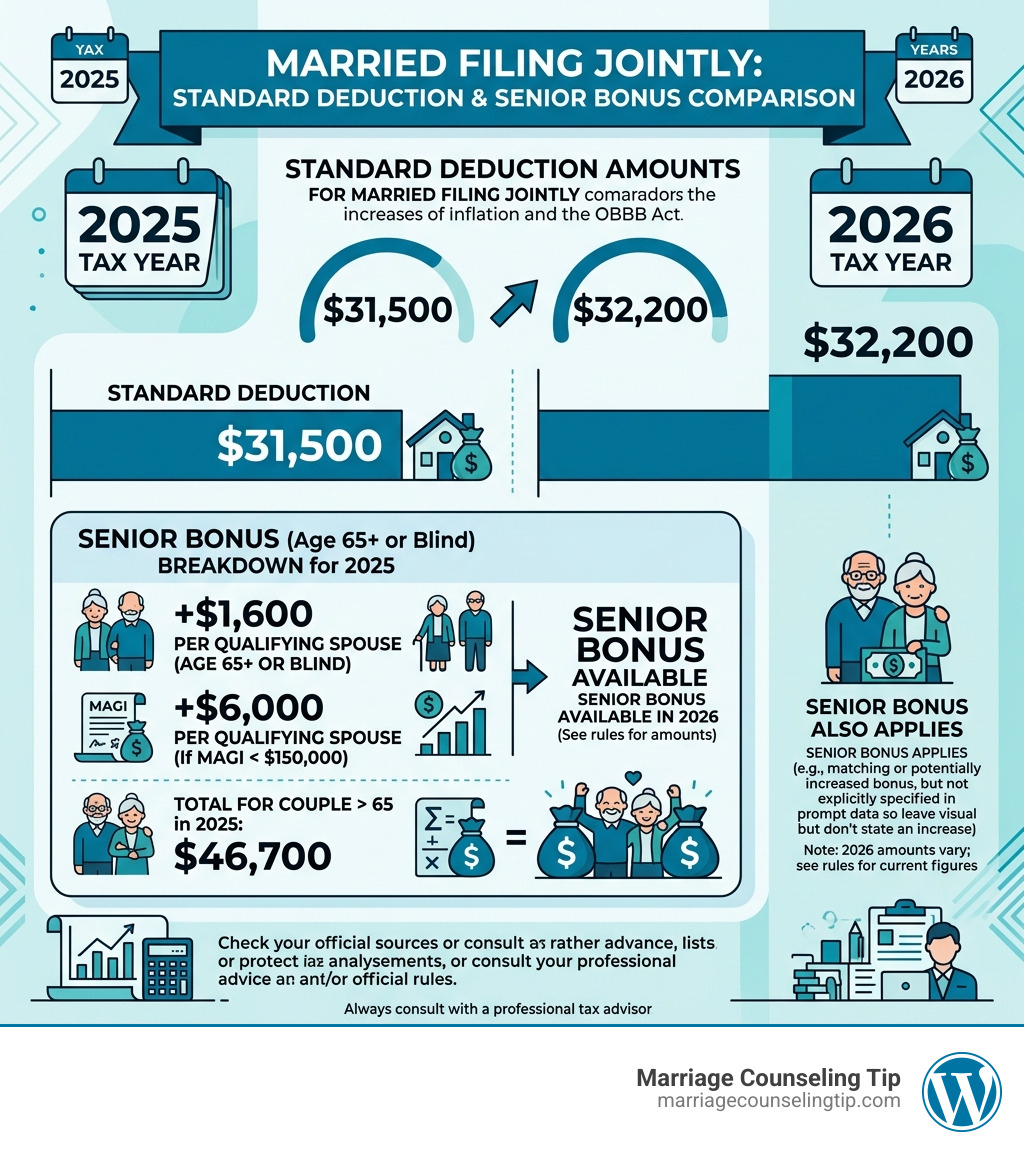
| 2026 | $32,200 |
And if you or your spouse are 65 or older, you can add even more:
- +$1,600 per qualifying spouse (age 65+ or blind) in 2025
- +$6,000 per qualifying spouse via the new senior bonus deduction (if MAGI is under $150,000)
- Total potential deduction for a couple both over 65 in 2025: $46,700
These increases are largely due to the One Big Beautiful Bill Act (OBBB), which pushed the 2025 standard deduction higher than original IRS inflation projections.
For most married couples, the standard deduction is the simplest and most valuable tax break available. About 88% of all tax filers choose it over itemizing — and for good reason. You don’t need receipts. You don’t need to track every expense. You just subtract a fixed amount from your income before taxes are calculated.
But here’s where it gets complicated for some couples.
If your spouse has IRS back taxes, unfiled returns, or a tax debt you didn’t know about, the decision to file jointly isn’t just a math problem. It can put your refund — and potentially your home — at risk. Understanding exactly what the standard deduction is worth, and whether joint filing is the right move, is the first step in protecting yourself.
Understanding the 2025 and 2026 Standard Deduction for Married Filing Jointly
When we talk about the standard deduction, we are talking about the “floor” of your tax return. It is the portion of your income that the IRS agrees not to tax, no questions asked. For those of us filing as a married unit, this floor is significantly higher than it is for single people.
In late 2025, the IRS released tax inflation adjustments for tax year 2026, which confirmed that the amounts are continuing to climb. This is largely a response to the “One Big Beautiful Bill” Act (OBBB), which sought to provide more breathing room for American families facing rising costs.
To give you a clear picture of how these amounts stack up, let’s look at the base figures:
| Filing Status | 2025 Tax Year | 2026 Tax Year |
|---|---|---|
| Married Filing Jointly | $31,500 | $32,200 |
| Single / Married Filing Separately | $15,750 | $16,100 |
| Head of Household | $23,625 | $24,150 |
Current Rates for Tax Year 2025
As we sit here in April 2026, many of us are finalizing our 2025 returns. For this tax year, the base amount for what is the standard deduction for married filing jointly is a robust $31,500.
This number was actually higher than many economists originally predicted. Thanks to the OBBB Act, the deduction was boosted from an estimated $30,000 to the final $31,500. This $1,500 “bonus” might not sound like a fortune, but when you apply your marginal tax rate to it, it represents a few hundred dollars kept in your pocket rather than sent to the Treasury.
Projected Increases for Tax Year 2026
Looking ahead to the taxes we will file next year, the IRS has already signaled that inflation indexing will push the joint deduction to $32,200. This $700 increase helps keep pace with the cost of living.
While some older websites might still show “e-File is closed” for these future years, the IRS has already codified these numbers. If you are planning your 2026 finances or adjusting your withholdings now, $32,200 is the number you should use for your joint deduction.
Maximizing Benefits: The OBBB Act and Senior Bonus Deductions
If you or your spouse have celebrated your 65th birthday, the standard deduction story gets a whole lot better. The OBBB Act introduced a game-changer called the “Senior Bonus Deduction.”

In the past, seniors got a modest “additional standard deduction” (which still exists). But the OBBB Act added a temporary “Senior Bonus” that is significantly more generous. For 2025 through 2028, qualifying seniors can claim an extra $6,000 each. For a married couple where both partners are 65 or older, that is a massive $12,000 deduction on top of everything else.
Calculating the Senior Bonus for what is the standard deduction for married filing jointly
To qualify for this $6,000-per-person bonus, there are some income rules to keep in mind. The OBBB Act was designed to help middle and lower-income seniors, so it includes a phase-out:
- Full Deduction: If your Modified Adjusted Gross Income (MAGI) is $150,000 or less as a married couple, you get the full $6,000 per person ($12,000 total).
- The Phase-Out: If your income is between $150,000 and $250,000, the bonus begins to shrink.
- The Cap: Once your joint MAGI exceeds $250,000, the $6,000 senior bonus disappears entirely.
If you are a “mixed-age” couple where only one spouse is 65+, you still get $6,000, provided you stay under those income limits.
Additional Standard Deduction for Age and Blindness
Don’t confuse the “Senior Bonus” with the “Additional Standard Deduction.” You actually get both.
For 2025, the additional standard deduction for being 65 or older (or legally blind) is $1,600 per person for married filers.
Let’s do the math for a couple where both are 65+ and their income is $130,000:
- Base Standard Deduction: $31,500
- Age Addition ($1,600 x 2): $3,200
- Senior Bonus ($6,000 x 2): $12,000
- Total Deduction: $46,700
This means nearly $47,000 of your income is completely tax-free. If you are looking for the right paperwork to claim these, you can often find them at Forms Fillable, Printable & Downloads.
Standard vs. Itemized: What is the Standard Deduction for Married Filing Jointly Worth?
We often get asked: “Should we just take the standard amount, or should we try to itemize?”
Statistically, the standard deduction wins. About 88% of taxpayers take it because it is nearly impossible for the average family to find more than $31,500 in specific expenses like mortgage interest or medical bills. However, the OBBB Act also made some changes to itemized deductions that might tip the scales for some.
When deciding, we always recommend looking at Filing Separately or Jointly – Which is Better? to see how your specific liabilities affect the choice. If you are dealing with a spouse who has tax debt, the “math” of the deduction might be less important than the “legal protection” of filing separately. You can read more about this in our guide: Is it Better to File Taxes Married Jointly or Married Separately?.
New SALT Deduction Limits Under OBBB
One of the biggest hurdles to itemizing in recent years was the $10,000 cap on State and Local Tax (SALT) deductions. If you lived in a high-tax state, you were stuck.
The OBBB Act temporarily raised this SALT limit to $40,000 for the years 2025 through 2029. This is a massive shift. For couples with high property taxes and state income taxes, itemizing might suddenly become more attractive than the $31,500 standard deduction. If you are considering this, be sure to check the Tax Brackets for Married Filing Separately to ensure you aren’t accidentally pushing yourself into a higher tax percentage by splitting up.
When to Choose Itemization Over the Standard Deduction
You should only itemize if your total “Schedule A” expenses exceed your standard deduction ($31,500 in 2025). These expenses typically include:
- Mortgage Interest: Usually the biggest driver for itemizing.
- Charitable Donations: If you are a high-giver, this can push you over the edge.
- Unreimbursed Medical Expenses: Only the portion that exceeds 7.5% of your AGI.
- SALT: Now up to $40,000 thanks to OBBB.
If your spouse has significant tax issues, you might feel pressured to file jointly to get that $31,500 deduction. But if he or she owes the IRS, that “savings” could be seized immediately. In those cases, we often suggest asking: Should I File Separately if My Husband Owes Taxes?.
Special Cases: Dependents and Filing Restrictions
Tax law is rarely “one size fits all.” There are special cases where the standard deduction rules change, particularly when you are dealing with dependents who are also filing their own returns.

Rules for Dependents on what is the standard deduction for married filing jointly
If you are supporting a dependent (like a college-aged child or an elderly parent) who earns a little bit of money, their standard deduction is limited. For 2025, a dependent’s standard deduction is the greater of:
- $1,350, OR
- Their earned income plus $450 (not to exceed the regular standard deduction).
This prevents families from “shifting” too much income to dependents to avoid taxes.
Furthermore, if you are married, you need to be aware of the “consistency rule.” If you and your spouse file separately, and one of you chooses to itemize, the other must also itemize—even if their itemized deductions are $0. This is a common trap for couples trying to navigate tax debt. Before you decide to split your returns, make sure you understand the answer to: Do You Have to File Your Taxes Together as a Married Couple?.
Frequently Asked Questions about the Standard Deduction
How do I claim the senior bonus deduction on Form 1040?
The senior bonus deduction is a bit different from the standard deduction. While the standard deduction sits on Line 12 of your Form 1040, the new OBBB Senior Bonus is often calculated on Schedule 1-A and then flows to Line 13b.
Most modern tax software will handle this automatically as long as you have entered your birthdate correctly in the “My Info” section. If you see a number like $34,700 on your return (the standard $31,500 + $3,200 age addition) and you’re wondering where your $12,000 bonus went, check Line 13b!
What happens to personal exemptions under the OBBB Act?
Personal exemptions are still gone. The OBBB Act made the “zero value” for personal exemptions permanent. In the old days, you got a standard deduction plus an exemption for every person in the house. Now, the IRS has simply rolled those exemptions into a much larger standard deduction. It’s cleaner, but it means you don’t get extra “points” just for having a larger family like you used to.
Can I take the standard deduction if my spouse itemizes separately?
No. This is one of the strictest rules in the tax code. If you file “Married Filing Separately,” you must both do the same thing. If your spouse itemizes $40,000 in deductions on their separate return, you are forced to itemize your return as well. If you have no deductions to claim, your deduction is $0. This is why communication is key—even if you are filing separately due to financial infidelity or tax debt.
Conclusion
Understanding what is the standard deduction for married filing jointly is about more than just knowing a number; it’s about knowing your options. For 2025, that $31,500 (or up to $46,700 for seniors) is a powerful tool to lower your tax bill.
At Marriage Counseling Tip, we know that taxes aren’t just about math—they are about trust. If you are dealing with financial infidelity or a spouse’s hidden tax debt, the standard deduction might feel like a small consolation. But by understanding these rules, you can make informed decisions that protect your financial future. Whether you need to explore innocent spouse relief or evaluate the best way to file amid back-tax debt, we are here to help you navigate the legal and emotional complexities of married finances.
Don’t let tax season tear your relationship apart. Take the time to run the numbers, talk to a professional, and protect your future from tax liability.