
The Truth About Qualifying for Spousal Tax Relief
When Your Spouse’s Tax Mistakes Become Your Problem
How hard is it to get innocent spouse relief is one of the most important questions you can ask if you’re facing a tax bill you didn’t create. The short answer: it’s genuinely difficult — but not impossible.
Here’s a quick breakdown of what you’re up against:
- Overall approval rate: 40-50% across all relief types
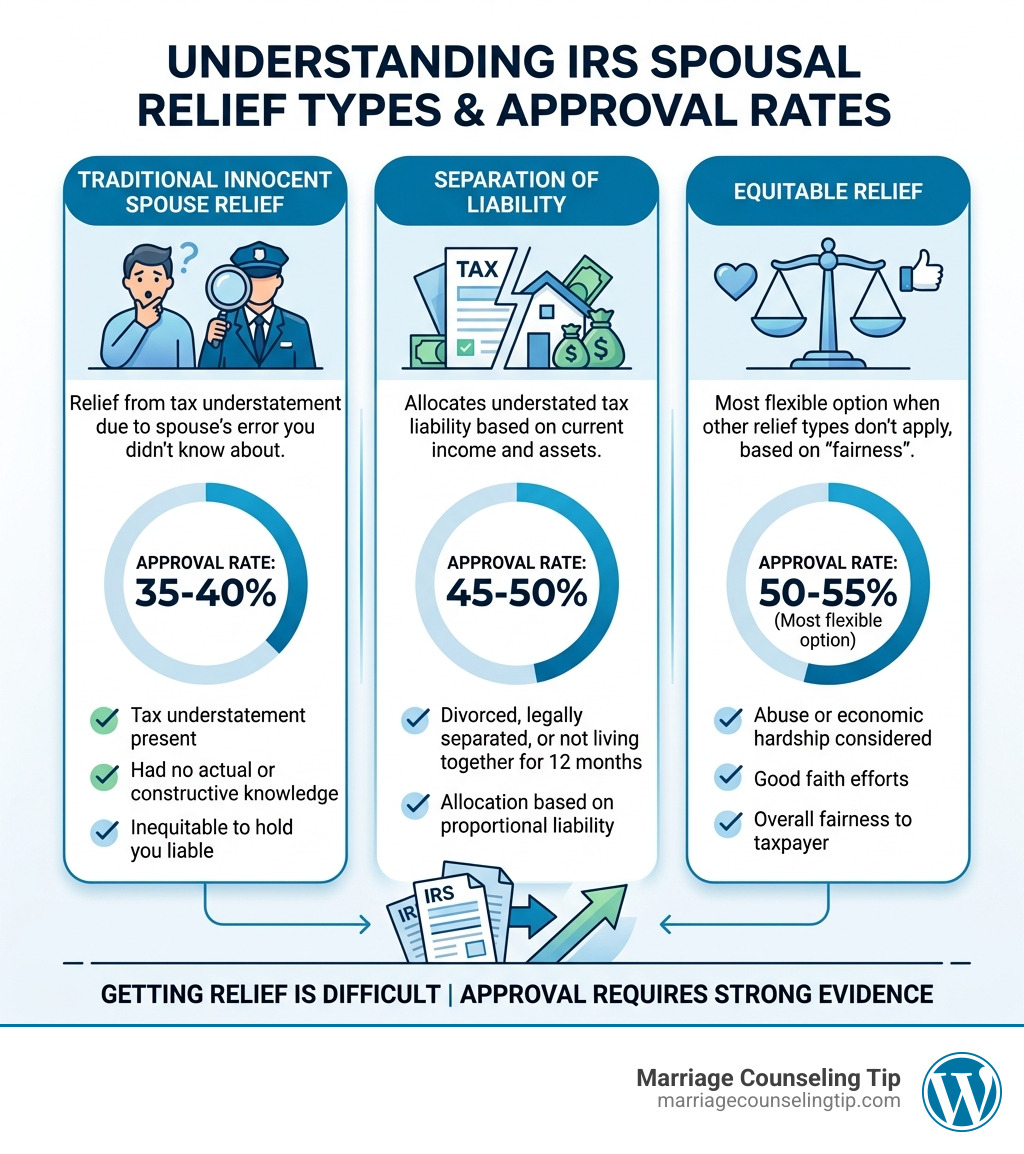
- Traditional innocent spouse relief: 35-40% approval
- Separation of liability relief: 45-50% approval
- Equitable relief: 50-55% approval (the most flexible option)
- Top denial reason: 48% of claims are rejected because the applicant couldn’t prove they had no knowledge of the errors
In 2021, the IRS received 26,179 innocent spouse relief requests. Only 4,807 were fully approved — roughly 1 in 5.
When you file a joint tax return, the law holds both spouses equally responsible for every dollar owed. That includes taxes, interest, and penalties — even if you earned none of the income and signed the return without knowing anything was wrong. This is called joint and several liability, and it doesn’t go away after a divorce.
For many people, discovering this feels like a gut punch. You trusted your spouse with the finances. You signed where they told you to sign. And now the IRS is coming after you.
The good news is that Congress created innocent spouse relief specifically for situations like yours. The hard part is actually qualifying for it.
How Hard Is It to Get Innocent Spouse Relief?

If you are wondering how hard is it to get innocent spouse relief, we have to be honest with you: the IRS does not hand these out like party favors. When you sign a joint return, you are essentially telling the government, “I vouch for every number on this page.” Retracting that statement later requires a mountain of proof.
As of April 2026, the statistics remain sobering. While the IRS receives over 50,000 applications in a typical year, fewer than half are granted based on the initial application alone. In fact, looking back at 2021 data, the full approval rate was a measly 18%. Many taxpayers receive “partial relief,” which means they are still on the hook for some of the debt.
To understand your chances, look at the historical approval rates by relief type:
| Relief Type | Estimated Success Rate |
|---|---|
| Traditional Innocent Spouse | 35-40% |
| Separation of Liability | 45-50% |
| Equitable Relief | 50-55% |
Why are so many people turned away? The IRS has identified four primary “deal-breakers” that lead to denials:
- Failure to prove lack of knowledge (48%): This is the biggest hurdle. If the IRS thinks you knew—or should have known—about the error, you’re out.
- Significant benefit (22%): If you enjoyed a lifestyle supported by the unpaid taxes (think luxury vacations or expensive jewelry), the IRS won’t consider you “innocent.”
- Incomplete documentation (15%): Many people treat Form 8857 like a simple questionnaire. In reality, it requires a legal-level defense of your situation.
- Missed deadlines (10%): There are strict clocks ticking the moment the IRS starts trying to collect from you.
At Marriage Counseling Tip, we see how these denials add salt to the wound of financial infidelity. It’s not just about the money; it’s about the feeling that the system is punishing you for your spouse’s deceit. For more details on the specific categories, check out what are the four types of innocent spouse relief.
The Three Paths to Escaping Joint Tax Liability
When you apply for relief, you don’t actually have to choose which “path” you want. You file Form 8857, and the IRS is supposed to evaluate you for all three. However, knowing the criteria for each helps us build a stronger case.
1. Traditional Innocent Spouse Relief
This applies when there is an understatement of tax—meaning your spouse omitted income or claimed fake deductions. To qualify under Publication 971 (12/2021), Innocent Spouse Relief | Internal Revenue Service, you must prove:
- You filed a joint return.
- The tax was understated due to “erroneous items” belonging to your spouse.
- When you signed, you didn’t know (and had no reason to know) about the error.
- It would be unfair to hold you liable.
2. Separation of Liability Relief
This is often easier to get because it doesn’t require you to be “innocent” in the moral sense. It simply asks the IRS to split the bill. You generally qualify if you are divorced, widowed, or have been legally separated (or living apart) for at least 12 months. The IRS reallocates the tax debt so you only pay the portion attributed to your own income or errors.
3. Equitable Relief
This is the “safety net.” If you don’t qualify for the first two, the IRS looks at the “fairness” of the situation. Crucially, this is the only path that allows relief for unpaid tax balances (when the return was filed correctly, but the money was never sent). If you live in a community property state (like Texas or California), special rules apply here regarding how income is attributed to each spouse.
Key Barriers: Why the IRS Denies Most Claims
The “Knowledge or Reason to Know” standard is the graveyard where most innocent spouse claims go to die. The IRS uses a “reasonable person” test: Would a normal person in your shoes have noticed something was fishy?
The Duty of Inquiry
If your spouse is a high-roller but your tax return shows they only made $30,000, the IRS expects you to ask questions. “Turning a blind eye” is legally considered the same as having actual knowledge. They look at your education level, your involvement in family finances, and whether there was a sudden, unexplained increase in your standard of living.
The Business Owner Hurdle
If you or your spouse own a business, the IRS is 30% more likely to deny your claim. They assume that business owners (and their spouses) are more financially sophisticated and should be monitoring the books. This is a major reason why we often discuss whether you should i file separately if my husband owes taxes to avoid this mess entirely.
Significant Benefit vs. Normal Support
If the money saved from the tax error was used for “normal support” (mortgage, groceries, basic utilities), you’re usually safe. But if that money paid for a boat, a second home, or a lavish wedding for your child, the IRS will argue that you “benefited” from the fraud and therefore shouldn’t be relieved of the debt.
Navigating the Application Process and Deadlines

To start the process, you must file Form 8857, Request for Innocent Spouse Relief. This isn’t a form you fill out in ten minutes over coffee. Successful applicants often submit 40 to 60 pages of evidence, including bank statements, divorce decrees, and detailed letters explaining the family dynamics.
The Two-Year Window
For Traditional Relief and Separation of Liability, you generally have a two-year deadline. This clock starts the moment the IRS begins “collection activity.” This could be a notice of intent to levy your wages or a refund offset. If you miss this window, your only remaining option is Equitable Relief, which has a much longer 10-year window for unpaid balances.
The Processing Timeline
Expect to wait. The IRS typically takes six months or longer to process these requests. During this time, they are legally required to contact your spouse (or ex-spouse) to get their side of the story. This can be terrifying for victims of domestic abuse.
Domestic Abuse Exceptions
If you were a victim of abuse or “duress,” the IRS may waive the knowledge requirement. If you signed the return only because you feared for your safety, or if your spouse maintained absolute control over the finances through intimidation, the IRS is much more likely to grant relief. In fact, documented abuse can boost approval rates by 30-40%. We provide extensive resources on surviving irs back taxes debt as a married couple while dealing with these sensitive dynamics.
What to Do If Your Request Is Denied
If you receive a preliminary denial, don’t panic. You have exactly 30 days to request a conference with the IRS Office of Appeals. This is your chance to talk to a human being who isn’t the original auditor.
If Appeals also says no, you have 90 days from the date of their final determination letter to file a petition with the U.S. Tax Court. This is a big step, but it’s often worth it. About 25-30% of Tax Court cases result in a win for the taxpayer after the IRS initially denied them.
In Tax Court, you get a “de novo” review, which is fancy Latin for “a fresh look.” The judge isn’t bound by what the IRS agent decided. However, this is where professional representation becomes vital. A tax attorney knows how to present the “equitable factors” that a computer algorithm might miss.
While the case is pending, the IRS generally cannot seize your property. This is a critical protection, especially if you’re worried about can the irs take my house if my husband owes back taxes. For future protection, it’s worth learning about filing separately or jointly which is better for your specific situation.
Frequently Asked Questions about Spousal Tax Relief
How hard is it to get innocent spouse relief if I signed the return?
It is harder, but not impossible. The IRS knows that most people sign joint returns without reading every line. Your goal is to show that even if you read it, you wouldn’t have understood the error because your spouse hid the truth. If your signature was forged or obtained through physical coercion, the “joint return” itself might be considered invalid, which is a different (and often more successful) path to relief. You can read more about the nuances of joint signatures in our guide on do you have to file your taxes together as a married couple.
How hard is it to get innocent spouse relief for unpaid taxes?
This falls under Equitable Relief. It’s arguably “easier” in terms of the legal standard because you don’t have to prove the return was wrong—just that you thought the bill was being paid. Under Revenue Procedure 2013-34, the IRS looks at whether you had a “reasonable expectation” that your spouse would pay the tax. If they took the money meant for the IRS and spent it on a gambling debt without your knowledge, you have a strong case for equitable relief.
Does my marital status affect my chances of success?
Absolutely. Being divorced, widowed, or legally separated makes you eligible for Separation of Liability, which is statistically more likely to be approved than traditional innocent spouse relief. A divorce decree that says “Husband shall be responsible for all 2023 taxes” does not bind the IRS, but it is excellent evidence to show the IRS who should be paying the bill. If your status changes after a denial, you may even be able to reapply in some circumstances.
Conclusion
At Marriage Counseling Tip, we believe that financial healing is a prerequisite for marital healing. Dealing with the IRS is one of the most stressful experiences a human can go through, and when that stress is caused by a partner’s “financial infidelity,” it can break a relationship.
Understanding how hard is it to get innocent spouse relief is the first step in taking your power back. It is a rigorous, document-heavy, and often frustrating process, but for the 40-50% of people who succeed, it offers a fresh start and a life free from a debt they didn’t earn.
If you are struggling with the psychological weight of tax debt or the betrayal of hidden financial mistakes, we are here to help. You don’t have to navigate the intersection of tax law and emotional recovery alone. Visit us at https://marriagecounselingtip.com/ for more guides on protecting your future and your peace of mind.