
Splitting Assets After Financial Betrayal
When Hidden Money Secrets Destroy a Marriage — and What It Costs You Legally
Financial infidelity and divorce are more connected than most people realize. If your spouse has been hiding debt, secret accounts, or undisclosed spending, you may already be facing serious legal and financial consequences — even if you didn’t know about it.
Here’s what you need to know right away:
- Financial infidelity = one spouse secretly hiding money, debt, accounts, or spending from the other
- It affects property division, spousal support, and child support in divorce proceedings
- Courts can penalize the deceptive spouse — awarding hidden assets entirely to the betrayed spouse
- Hidden debt can become your problem too, depending on your state’s laws
- You have legal tools available: forensic accountants, subpoenas, and discovery processes can uncover the truth
More than 40% of couples who share finances admit to hiding cash, purchases, or lying about debt. And roughly one-third of divorced Americans say credit card debt and financial secrets were a key reason their marriage ended.
This isn’t just about hurt feelings. It’s about your financial future.
Whether you’re dealing with a spouse’s secret IRS debt, undisclosed credit cards, or hidden assets — the betrayal cuts deep on two levels: emotional and legal.
As one financial expert put it, credit card debt and out-of-control spending pose serious relationship challenges, made significantly worse when they’re hidden from a partner.
The stakes are high. But understanding your rights is the first step to protecting yourself.
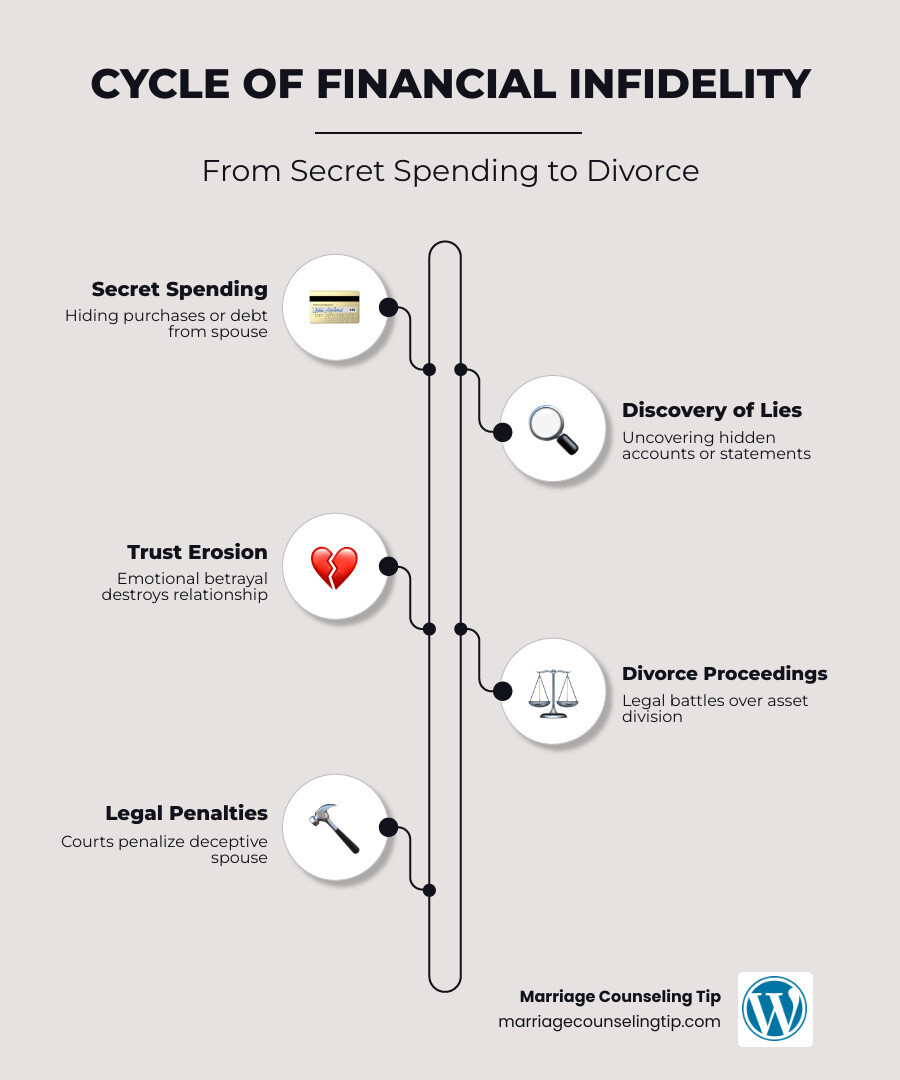
Financial infidelity and divorce terms explained:
Defining Financial Infidelity and Divorce Risks
At its core, financial infidelity is a breach of the “economic contract” of marriage. We often think of cheating in physical or emotional terms, but Financial Infidelity: The Cost of Keeping Secrets can be just as devastating. In fact, 52% of people believe financial cheating is just as bad as a physical affair, and 12% believe it is actually worse.

So, what does this look like in the real world? It isn’t just a small disagreement over a grocery bill. It involves intentional deceit. Common examples include:
- Secret Spending: Buying luxury items, gadgets, or even funding a secret apartment or an outside relationship.
- Hidden Accounts: Opening bank accounts or credit cards in one’s own name without the other spouse’s knowledge.
- Undisclosed Debt: Racking up thousands in credit card debt or taking out secret loans.
- Income Deception: Hiding bonuses, commissions, or side-hustle income.
The link between financial infidelity and divorce is statistically undeniable. Research shows that financial infidelity and credit card debt are behind one-third of divorces. When one partner prioritizes their own “financial autonomy” over the transparency required in a partnership, the foundation of trust crumbles. Once that trust is gone, many couples find it impossible to reconcile, leading them straight to the family court system.
Red Flags of Financial Betrayal
If you suspect something is off, don’t ignore your gut. While every relationship has its quirks, certain behaviors are classic indicators that your spouse might be committing marital financial deception:
- Unexplained Withdrawals: Large or frequent cash withdrawals from joint accounts that can’t be accounted for.
- Defensive Behavior: If you ask a simple question about a bill and get an explosive or evasive reaction, they might be hiding something.
- Missing Mail: If your spouse suddenly insists on being the only one to check the mailbox, or if bank statements that used to arrive at the house suddenly stop, pay attention.
- New Credit: Finding a new credit card in their wallet or seeing a sudden dip in your joint credit score.
- Lifestyle Discrepancies: Your spouse has new clothes or expensive hobbies that don’t match the “official” family budget.
- Secretive Passwords: Suddenly changing passwords on financial apps or refusing to share login information for joint accounts.
Legal Consequences of Asset Dissipation
When a marriage enters the divorce phase, the law views the couple’s finances through a very specific lens. In many states, spouses owe each other a “fiduciary duty.” This is a fancy legal term meaning you have a high obligation to act in good faith and fair dealing regarding marital assets.

When one spouse hides money, they aren’t just being sneaky; they are potentially violating the law. In the context of financial infidelity and divorce, courts look for “dissipation of assets.” This happens when one spouse uses marital funds for a purpose unrelated to the marriage—like spending money on a secret paramour, gambling, or simply hiding it in a shell account.
If the court finds evidence of this, they may “reconstitute” the marital estate. This means the judge acts as if the wasted or hidden money is still there and awards the innocent spouse a larger share of the remaining assets to make up for the loss. In extreme cases, such as in California, if a spouse is caught hiding an asset, the court can award 100% of that specific asset to the innocent partner.
Community Property vs. Equitable Distribution
How your assets are split depends heavily on where you live. Here is a quick comparison:
| Feature | Community Property States | Equitable Distribution States |
|---|---|---|
| Basic Rule | Assets acquired during marriage are owned 50/50. | Assets are divided “fairly” but not always equally. |
| Handling Debt | Often shared equally, even if secret. | Debt is assigned based on who benefited. |
| Court Discretion | Less flexibility, but can penalize for fraud. | High flexibility to adjust for “fault” or deceit. |
| Financial Infidelity Impact | Can lead to sanctions or asset forfeiture. | Often results in a lopsided asset split for the victim. |
Beyond just splitting the house and the 401(k), the deceptive spouse might be ordered to pay the other’s attorney fees or face legal sanctions for their dishonesty.
Discovery and Evidence Gathering
You cannot fight what you cannot see. If you suspect financial infidelity and divorce is on the horizon, the “discovery” phase of your legal case will be the most important part of the process. This is the formal period where both sides must exchange information.
We always recommend starting with the basics. You’ll need to gather:
- Bank Statements: Look for transfers to unknown accounts.
- Tax Returns: These are a goldmine. Look for reported interest from bank accounts you didn’t know existed or “business losses” that seem suspicious.
- Credit Reports: This will show every open line of credit in your spouse’s name.
- Pay Stubs: Check for undisclosed retirement contributions or “voluntary” deductions that are actually going into secret savings.
If the situation is complex—for example, if your spouse owns a business or deals in cryptocurrency—you may need to issue subpoenas. These are court orders that force banks, employers, or even cell phone providers to turn over records. Interrogatories (written questions that must be answered under oath) and depositions (in-person questioning under oath) are also powerful tools to pin down a deceptive spouse.
Uncovering Financial Infidelity and Divorce Evidence
For those dealing with a high-net-worth spouse or a business owner, evidence gathering often moves into “asset tracing.” This involves looking for:
- Hidden Income: Are they deferring a bonus until after the divorce is final?
- Expense Analysis: Are they “padding” business expenses to make their personal income look lower?
- Digital Assets: Cryptocurrency is a favorite for those committing financial infidelity. Tracing “wallets” and exchange transfers requires specialized digital forensics.
- Professional Consultation: Don’t try to be a detective alone. Working with an attorney who specializes in financial deceit is crucial.
Frequently Asked Questions
Can financial infidelity and divorce lead to legal penalties?
Yes. If a spouse lies about their finances during a divorce, they are lying under oath. This can lead to contempt of court charges. In severe cases of fraud or perjury (lying on your financial affidavit), a spouse could face fines or even jail time. Most commonly, the penalty is financial: the judge may award the innocent spouse a much larger portion of the marital estate or order the deceptive spouse to pay all legal fees.
How does secret debt affect property division?
This is a major concern for many. If your spouse racked up $50,000 in secret credit card debt, are you responsible? In many “equitable distribution” states, the court will look at what the money was spent on. If it was spent on “marital purposes” (like groceries or kids’ school clothes), you might be partially liable. However, if it was spent on an affair, gambling, or personal luxuries the other spouse didn’t know about, the court will often assign that debt solely to the spouse who incurred it.
What is the role of a forensic accountant?
Think of a forensic accountant as a financial private investigator. They perform a lifestyle analysis to see if your spouse’s reported income matches their actual spending. They are experts at finding hidden accounts, verifying income, and valuing complex assets like businesses or stock options. Their expert testimony in court is often the “smoking gun” needed to prove financial infidelity.
Conclusion
At Marriage Counseling Tip, we have seen how financial secrets can tear a family apart. Whether it’s the shock of discovering secret credit cards or the crushing weight of IRS back taxes you never knew existed, the path forward is difficult—but not impossible.
If you are facing financial infidelity and divorce, you have rights. From seeking innocent spouse relief with the IRS to hiring a forensic team to trace every penny, there are legal protections designed to keep you from paying for your partner’s mistakes.
Rebuilding your life after financial betrayal requires a two-pronged approach: legal strategy and emotional healing. While the court handles the assets, you must handle the recovery. Whether you choose to work on the marriage through specialized financial infidelity counseling or move forward into a healthy, independent future, transparency must be your new baseline.
Don’t let a spouse’s secrets bankrupt your future. Knowledge is power, and documentation is your best defense. For more guides on navigating the intersection of taxes, debt, and marriage, visit our website.