
Is Your Partner Hiding Debt? Look for These Red Flags
When Hidden Money Becomes Hidden Betrayal
The signs of financial infidelity can be easy to miss — until the damage is already done.
Here are the most common warning signs to watch for:
- Unexplained withdrawals from joint accounts
- Secret credit cards or bank accounts your partner hasn’t mentioned
- Intercepted mail — your partner grabbing statements before you can see them
- Defensiveness or anger when you bring up money
- New purchases or luxury items with no clear explanation
- Missing or switched-to-email bank statements you never see
- Inconsistencies between lifestyle and income that don’t add up
- Sudden interest in cryptocurrency or investments you weren’t told about
- Unexplained cash withdrawals or checks made out to cash
- Passwords changed on financial accounts you used to share
Financial infidelity is formally defined as engaging in any financial behavior your partner would disapprove of — and intentionally hiding it from them. It’s not a forgotten receipt or an impulse buy at the grocery store. It’s a pattern of deliberate secrecy around money.
And it’s far more common than most people realize.
Research suggests financial infidelity occurs somewhere in 27% to 41% of relationships. A large Harris Poll found that 43% of adults who share finances admitted to some form of financial deception. One in three married people say they’ve hidden a purchase from their spouse. Nearly one in three have a credit card their partner doesn’t know exists.
For married individuals already worried about a spouse’s hidden debt — especially tax debt — these numbers aren’t just statistics. They’re a reality check.
Financial infidelity involves a cycle of deception similar to emotional infidelity: one lie leads to another to cover the first.
The financial and emotional consequences can be severe. Hidden debt doesn’t stay hidden forever — and when it surfaces, it can threaten shared assets, credit scores, and even your home.
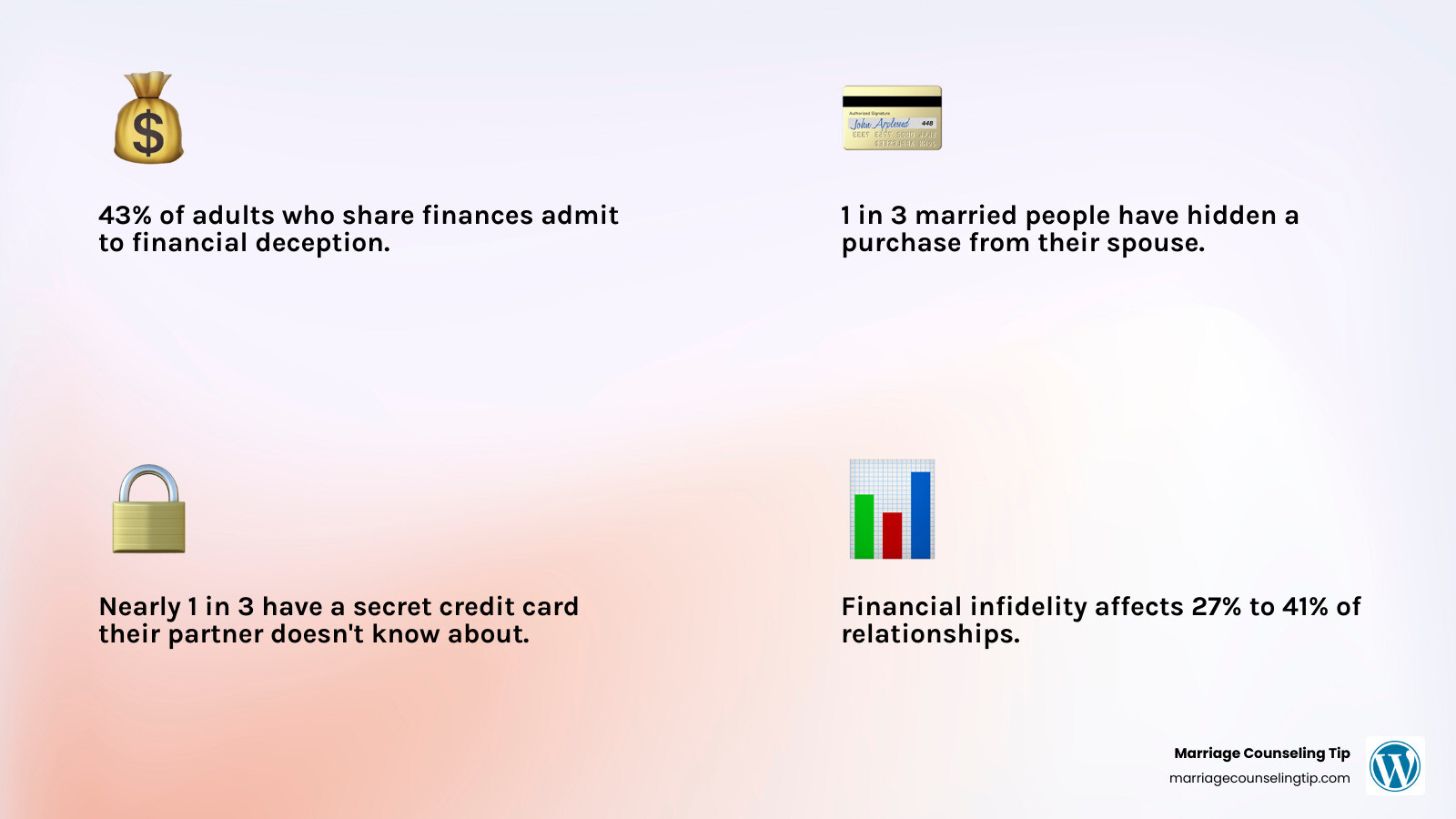
Signs of financial infidelity terminology:
Understanding Financial Infidelity vs. Disagreement
In any long-term relationship, money is bound to cause a few sparks. In fact, about 41% of married couples report that fighting occurs around the topic of money. But there is a massive difference between a heated debate over the grocery budget and true financial infidelity.
According to Financial Infidelity: When Couples Lie to Each Other About Money, the defining factor is intentional secrecy.
A financial disagreement happens when you and your partner are both looking at the same bank statement and arguing about whether that new espresso machine was a “need” or a “want.” You’re both on the same page regarding the facts; you just have different priorities.
Financial infidelity, however, is rooted in deceptive behavior. This is when one partner purposefully hides the espresso machine in the trunk of the car or opens a secret credit card to pay for it. Many people wonder, Is Hiding Money From Your Spouse Wrong? From a relationship perspective, the answer is almost always yes because it erodes the foundation of trust.
It’s also important to distinguish between financial infidelity and simple financial irresponsibility. Someone who is irresponsible might be bad at math, forget to pay a bill, or consistently overspend. However, they aren’t necessarily lying about it. When that irresponsibility turns into a “don’t ask, don’t tell” policy, you’ve crossed into the territory of infidelity.
You might find yourself asking, Is It Ok To Hide Money From Your Spouse if it’s for a “good” reason, like helping a struggling family member? Even with good intentions, the lack of transparency creates a wedge. For those with religious or moral frameworks, the question often becomes Is Hiding Money From Your Spouse A Sin? Regardless of the label, the result is the same: a breakdown of the “team” mentality required for a healthy marriage.
10 Common Signs of Financial Infidelity
Detecting financial secrets requires a bit of detective work, but once you know what to look for, the patterns become clear.
1. Unexplained Withdrawals
If you notice $200 or $300 leaving your joint checking account every Friday with no receipt or explanation, pay attention. These “leakages” often fund habits or debts that a partner doesn’t want you to track.
2. Secret Credit Cards
Finding a card in a drawer or a statement from a bank you don’t use is a major red flag. The signs of financial infidelity you can’t ignore and how to avoid it often begin with that one “emergency” card that quickly becomes a source of hidden debt. When Your Partner Cheats With A Credit Card, they are essentially borrowing against your shared future.
3. Intercepted Mail
Is your partner suddenly the only one who checks the mailbox? Are they racing to the door when the mail carrier arrives? They might be trying to hide “past due” notices or new credit card offers.
4. Lying About Prices
This is a “gateway” sign. Lying To Your Spouse About How Much Money You Spent—saying a $500 jacket was only $50—creates a habit of dishonesty that can escalate into hiding thousands of dollars in debt.
5. New Luxury Items
If your spouse comes home with a new watch, designer bag, or high-end golf clubs but claims they “got it on sale” or “borrowed it from a friend,” be skeptical. These 6 Signs of Financial Infidelity…and 5 Ways to Work It Out often point to a partner living a lifestyle their income shouldn’t support.
6. Sudden Defensiveness
When you ask a simple question like, “How much is left in the savings account?” and get met with anger or accusations like “Why don’t you trust me?”, you are likely hitting a nerve.
7. Missing Statements
If your paper statements stop coming or you find you no longer have the password to the online banking portal you once shared, your partner may be intentionally locking you out of the loop.
8. Secret Accounts
Discovering a bank account in only one partner’s name—especially if it was opened after you married—is a classic sign of squirreling away money or hiding spending.
9. Lifestyle-Income Discrepancies
If your combined income is $100,000 but you’re living like you make $200,000, the math has to balance somewhere. Usually, it’s balancing on a mountain of hidden credit card debt.
10. Financial Controlling
Sometimes, the person committing the infidelity is the one who insists on “handling everything.” By taking total control, they ensure you never see the mess they are making behind the scenes.
| Healthy Financial Habit | Red Flag Behavior |
|---|---|
| Openly discussing major purchases | Making big buys and hiding the receipts |
| Shared access to all accounts | Changing passwords or “forgetting” to share them |
| Regular “money dates” to review budget | Getting angry or avoidant when money is mentioned |
| Mutual agreement on financial goals | One partner making unilateral investments or loans |
Behavioral Signs of Financial Infidelity
Beyond the numbers, the signs of financial infidelity often manifest in how your partner acts. You might notice “money avoidance,” where they physically leave the room if a commercial about debt comes on, or they might have emotional outbursts over small, unrelated things because the stress of their secret is boiling over.
According to What Are The Signs Of Financial Infidelity?, gaslighting is a common tactic. If you point out a discrepancy, they might tell you that you’re “crazy,” “bad with money,” or “imagining things.” This is a defensive maneuver designed to make you stop asking questions. You can find a more exhaustive list in 14 Signs of Financial Infidelity, which highlights how secretive browsing and “work emergencies” can be used as cover for financial misdeeds.
Digital Signs of Financial Infidelity
In the modern era, financial secrets aren’t just in paper ledgers; they’re on smartphones. Look for hidden apps or payment platforms like Venmo and CashApp where transactions are harder to track. What Is Financial Infidelity? Common Signs & Examples notes that many partners now use cryptocurrency or “fintech” apps to move money anonymously. If your partner has suddenly become a “crypto bro” but won’t show you the wallet balance, there may be cause for concern.

The Impact: From Emotional Betrayal to Legal Consequences
The fallout of financial infidelity is two-fold: it breaks your heart and it can break your bank. Emotionally, the victim often feels as betrayed as if their partner had a physical affair. You feel foolish, ignored, and unsafe in your own home.
Legally, the situation can get even stickier. Many spouses ask, Is Hiding Money From Your Spouse Illegal? While it might not land them in jail during the marriage, it becomes a massive issue during divorce proceedings. In many jurisdictions, hiding assets is a form of fraud. So, Is Hiding Money From Your Spouse A Crime? It can lead to contempt of court or being forced to pay the other spouse’s legal fees.
If you head toward divorce, you may need to hire a forensic accountant to find the paper trail. Is Hiding Assets From Spouse Illegal? Absolutely, and courts do not take kindly to it when dividing the “property pool.”
Perhaps the most terrifying impact is tax debt. If your spouse has been hiding income or “fudging” the numbers on joint tax returns, you could be held liable by the IRS. This is where Tax Infidelity Recovery Tools And Guides To Survive The Secret Debt become essential. At Marriage Counseling Tip, we specialize in helping spouses navigate “innocent spouse relief,” which can protect you from being held responsible for your partner’s tax fraud or errors.
How to Recover and Rebuild Financial Trust
If you’ve discovered the signs of financial infidelity, your relationship is at a crossroads. It doesn’t always have to end in divorce, but it does require a total overhaul of how you handle money.
1. The “Come Clean” Conversation
The first step is a full disclosure. This shouldn’t be a screaming match. Instead, approach it like a business meeting. Both partners need to bring every statement, every debt, and every secret account to the table. Surviving The Secret Spend A Guide To Recovery suggests that without 100% honesty at this stage, recovery is impossible.
2. Implement Joint Budgeting
Secrecy thrives in separate accounts. While some couples prefer “hybrid” models, those recovering from infidelity often benefit from a “yours, mine, and ours” approach with full visibility. Use a zero-based budget where every dollar is accounted for.
3. Seek Professional Help
This isn’t just a money problem; it’s a trust problem. Healing The Wallet Online Counseling For Financial Secrets can help address the psychological reasons why the lying started in the first place—whether it was fear, a need for control, or an addiction. Marriage Counseling Tip provides resources to bridge the gap between financial planning and emotional healing.
4. Create a “Transparency Clause”
Agree that any purchase over a certain amount (say, $100) must be discussed. This isn’t about “asking permission” like a child; it’s about acting like a partner.

Frequently Asked Questions about Signs of Financial Infidelity
How common is financial infidelity in modern relationships?
It’s incredibly common. Statistics show that up to 43% of people have committed some form of financial deception. Interestingly, younger generations like Gen Z and Millennials are actually more likely to admit to financial infidelity than Boomers, often because they grew up with more “hidden” digital payment options.
Can a marriage survive after secret debt is discovered?
Yes, but it requires a “transparency clause” and a commitment to behavioral change. The partner who lied must be willing to give up some financial privacy for a period of time to prove they are trustworthy again. Counseling is often the “glue” that keeps the couple together during this stressful rebuilding phase.
What is the difference between financial infidelity and financial abuse?
This is a critical distinction. Financial infidelity is about secrecy—hiding things to avoid conflict or shame. Financial abuse is about control. In an abusive situation, one partner uses money to trap the other, withholding access to funds, forbidding the partner from working, or monitoring every cent to instill fear. If you feel unsafe or trapped, please reach out to a domestic violence hotline.
Conclusion
The signs of financial infidelity are often the smoke before the fire. Whether it’s a secret credit card or a hidden tax bill, these secrets can incinerate the trust you’ve spent years building. However, by choosing transparency over secrecy, you can turn a financial crisis into an opportunity for a stronger, more honest partnership.
If you are currently dealing with the fallout of a partner’s secret debt—especially if it involves the IRS—don’t face it alone. There are legal and psychological paths forward that protect your future and your peace of mind.