
Expert Advice on Finding the Right Counselor for Tax Infidelity
When Your Spouse’s Tax Secrets Become Your Crisis
Tax infidelity counseling advice is something more couples need than most people realize — and finding the right help fast can protect your finances, your marriage, and your legal standing.
Here’s a quick overview of what to do:
- Stay calm and gather evidence — collect tax returns, bank statements, and IRS notices before confronting your spouse
- Consult a tax attorney or CPA — understand your liability exposure as a joint filer
- Explore innocent spouse relief — if your spouse hid income or falsified deductions on a joint return, you may qualify for IRS protection
- Seek a couples counselor or financial therapist — someone trained in financial betrayal, not just general therapy
- Consider filing separately going forward — to prevent future shared liability while issues are unresolved
Finding out your spouse has been hiding IRS debt, underreporting income, or falsifying deductions is a gut punch. It’s not just a money problem. It’s a trust problem — and it can put your home, wages, and credit at serious risk.
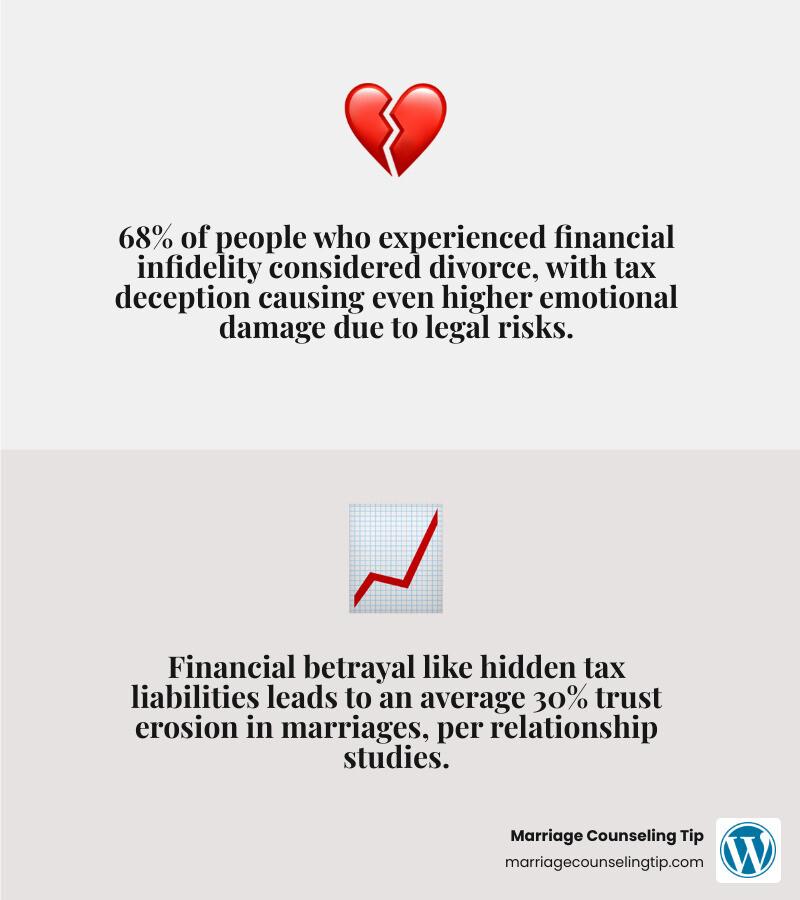
Financial deception is already shockingly common. According to the National Endowment for Financial Education, 43% of Americans who combine finances with a partner admit to some form of financial deception. And 85% of those said it damaged their relationship in some way.
Tax infidelity takes that betrayal further. When a spouse lies on a joint tax return, the IRS can hold you responsible — even if you had no idea it was happening.
The emotional fallout mirrors what people feel after a romantic affair: shock, anger, shame, and a deep loss of security. One spouse described discovering her husband’s hidden debt as a complete blindside — despite years of trusting him with their finances entirely.
The good news? With the right professionals and the right process, many couples do recover — both financially and emotionally.
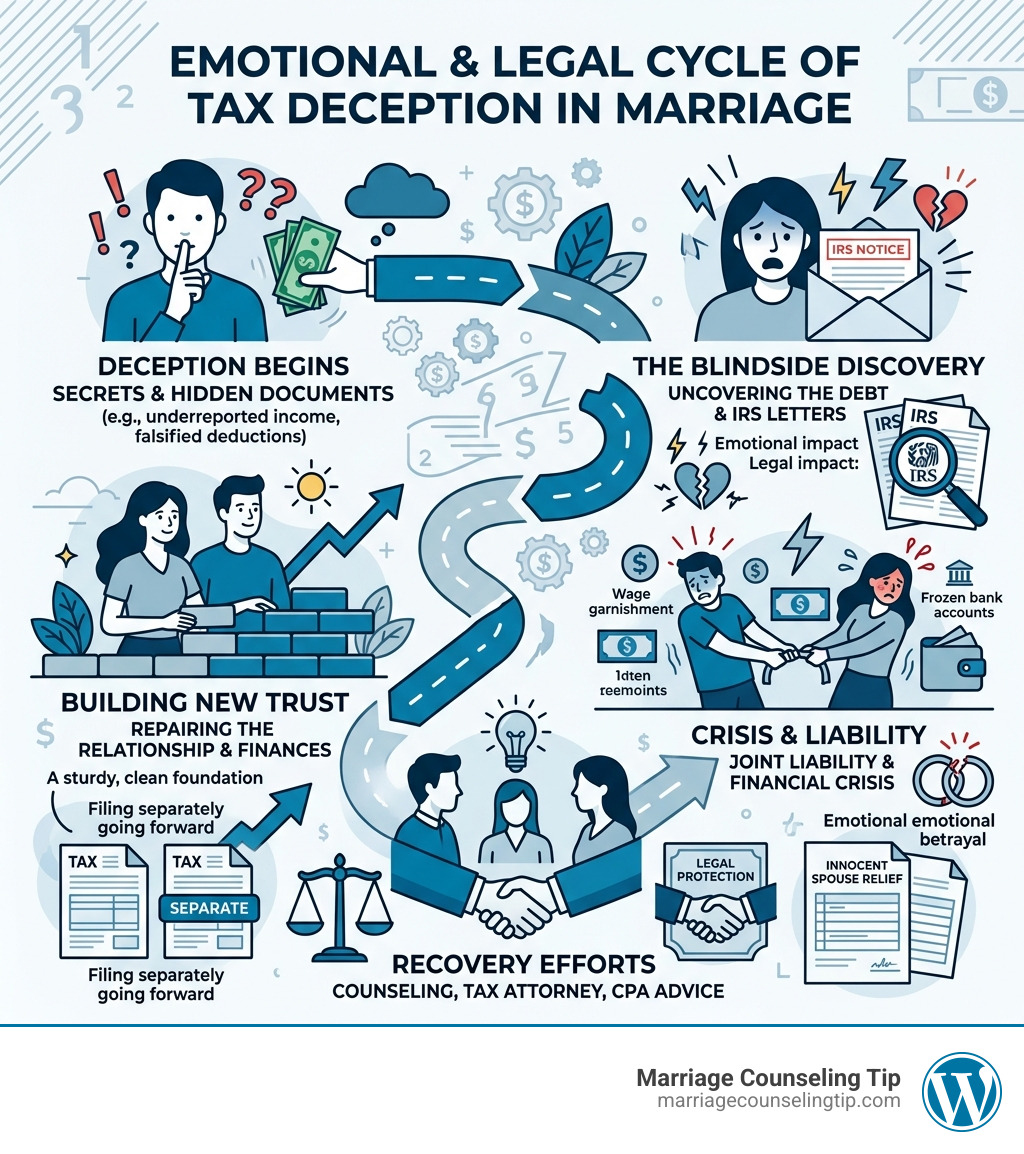
Easy tax infidelity counseling advice glossary:
Understanding Tax Infidelity vs. General Financial Deception

While general financial infidelity involves hiding purchases or secret credit cards, tax infidelity is a more dangerous beast. It occurs when one partner intentionally misrepresents information to the IRS on a joint return or hides tax-related liabilities from their spouse.
Common forms of tax infidelity include:
- Hiding Income: Not reporting side-hustle earnings, bonuses, or gambling wins.
- Falsifying Deductions: Claiming personal expenses as business costs or inflating charitable donations.
- Concealing Debt: Hiding the fact that the IRS has filed a lien or is planning to garnish wages.
The primary difference lies in the joint liability. If your spouse spends $5,000 on a secret credit card, you might be upset, but you aren’t necessarily legally responsible for that debt unless your name is on the account. However, if you sign a joint tax return that contains lies, the IRS views you as equally responsible for the full tax bill, plus interest and penalties. According to research from Psychology Today, this type of secrecy is often a symptom of deeper power imbalances or fear within the relationship.
As noted by Advent Valuation Advisors, the IRS doesn’t care if your divorce decree says your ex-husband is responsible for the taxes; if it was a joint return, they can still come after you.
Why Partners Hide Tax Liabilities
Understanding the “why” isn’t about making excuses, but about finding a path to healing. In our experience, partners rarely set out to ruin their family’s lives. Instead, they get trapped in a cycle of shame and escalating lies.
| Feature | Financial Irresponsibility | Intentional Tax Infidelity |
|---|---|---|
| Intent | Carelessness or forgetting | Deliberate concealment |
| Method | Losing a receipt | Falsifying documents/signatures |
| Risk | Overdraft fees | Federal prosecution/IRS liens |
| Communication | “I forgot to tell you” | “Everything is fine” (while hiding notices) |
Common drivers include:
- Shame and Guilt: They made a mistake one year and tried to “fix” it the next, only to make it worse.
- Addiction: Gambling or substance abuse often requires hidden funds and leads to tax evasion.
- Identity Loss: A spouse who feels they’ve lost their professional identity may hide financial failures to maintain a facade of success.
- Fear of Conflict: They worry that a large tax bill will lead to an explosive argument, so they hide the notice in a drawer.
The Legal and Emotional Fallout of Tax Betrayal
The consequences of tax infidelity are twofold: the “math” problem and the “heart” problem. On the legal side, the IRS has massive reach. They can garnish your wages, seize your bank accounts, and even place a lien on your home. If you are going through a divorce, these hidden liabilities can drastically change asset division.
As highlighted by Couples Learn, the emotional toll is often compared to physical infidelity. The betrayed spouse feels a profound sense of “financial gaslighting”—questioning their reality and wondering what else was a lie. This erosion of trust can lead to PTSD-like symptoms, including hyper-vigilance about every dollar spent.
Warning Signs of Spousal Tax Cheating
If you suspect something is off, don’t ignore your gut. Here are the red flags:
- Missing Mail: You notice you haven’t seen a W-2 or a 1099 that usually arrives, or the IRS “pink letters” never make it to the kitchen table.
- Accountant Isolation: Your spouse insists on meeting with the tax preparer alone or refuses to let you see the final return before you sign.
- Password Changes: Suddenly, you are locked out of joint bank accounts or the online IRS portal.
- Lifestyle Discrepancies: Your spouse is spending way more than their reported income would allow.
- Defensiveness: Simple questions about the tax refund lead to anger or “why don’t you trust me?” deflections.
Seeking Professional Tax Infidelity Counseling Advice
When tax lies come to light, you need a “dream team” of professionals. This isn’t a situation where a standard talk therapist is enough. You need experts who understand the intersection of tax law and relationship psychology.
We recommend involving:
- A Financial Therapist or Specialized Counselor: To navigate the betrayal trauma.
- A Tax Attorney or CPA: To handle the IRS and determine if you qualify for “Innocent Spouse Relief.”
- A Fiduciary Financial Advisor: To create a transparent roadmap for the future.
According to Select Counseling, the goal of counseling is to move from a state of “financial policing” to a partnership of “financial transparency.”
Identifying the Best Tax Infidelity Counseling Advice for Your Situation
The right counselor will use structured methods like the Gottman Method to help you communicate without the “Four Horsemen” (criticism, contempt, defensiveness, and stonewalling).
Effective tax infidelity counseling advice often starts with a financial ceasefire. This means no major purchases and no new financial moves without mutual consent while you are in the “triage” phase of recovery. Counselors also help the unfaithful partner understand the “emotional debt” they owe. Paying back the money is only half the battle; they must also do the work to restore the sense of safety they broke.
As Rosa Dinelli, LPC points out, the unfaithful partner must be willing to sacrifice some privacy in the short term to rebuild the long-term trust of the relationship.
How to Rebuild Trust with Tax Infidelity Counseling Advice
Rebuilding trust is a marathon, not a sprint. It requires radical honesty.
- Full Disclosure: The offending spouse must bring every document to the table. No partial confessions. Partial confessions are just more lies in disguise.
- Shared Passwords: For at least a year (or longer), both partners should have full access to all bank accounts, credit card portals, and IRS accounts.
- Monthly Money Dates: Set a recurring time to review the budget, tax withholdings, and any IRS correspondence.
- Transparency Measures: Use apps like EveryDollar to track spending in real-time so there are no surprises at the end of the month.
Toltec Therapy emphasizes that the goal isn’t for one person to control the other, but for both to become “teammates” against the problem.
Practical Steps to Recover and Prevent Future Deception

Once the emotional dust settles, you need a plan to protect yourself legally. This is where the “marriage” meets the “law.”
- Innocent Spouse Relief: This is a specific IRS provision. If you can prove that you didn’t know (and had no reason to know) about the tax errors, and that it would be unfair to hold you liable, the IRS may release you from the debt.
- Injured Spouse Relief: This applies if your portion of a joint refund was seized to pay for your spouse’s past-due debts (like child support or student loans).
- Separate Filing: While “Married Filing Separately” often results in a higher tax bill, it provides a “firewall” between your finances and your spouse’s potential tax mistakes.
Immediate Actions After Discovery
If you just found a hidden tax lien or a box of unopened IRS notices, take these steps immediately:
- Gather Evidence: Take photos or make copies of everything. Do not let the documents “disappear.”
- Stay Calm: An explosive confrontation often leads to more lying. Approach your partner with facts, not just feelings.
- Pull Your Credit Report: Check for any secret loans or credit cards that might be tied to the tax issues.
- Consult an Expert: Before you sign anything new or talk to the IRS, speak with a tax professional.
- Secure Your Own Credit: Consider a credit freeze to prevent any new debt from being opened in your name without your knowledge.
Frequently Asked Questions about Tax Infidelity
Is tax infidelity a deal-breaker for marriage?
Not necessarily, but it is a “crisis point.” If the partner who lied is willing to be 100% transparent, seek counseling, and take responsibility for the financial mess, many marriages emerge stronger. However, if the lying continues or they refuse to grant you access to the accounts, it may be a sign of a deeper personality issue or addiction that makes reconciliation impossible.
How does the IRS handle innocent spouse relief?
The IRS looks at several factors: whether you signed the return under duress, your level of involvement in the family finances, and whether you benefited from the “extra” money (e.g., did you go on a luxury vacation with the money that should have gone to taxes?). It is a complex process that usually requires a tax attorney.
Can counseling help if my partner is still lying?
Counseling can only work if both parties are committed to the truth. If your partner is still “trickle-truthing” (giving you small bits of information while still hiding the big picture), a counselor can help you set boundaries and decide if the relationship is safe for you to stay in.
Conclusion
At Marriage Counseling Tip, we believe that tax infidelity doesn’t have to be the end of your story. It is a devastating betrayal, but it is also a wake-up call. By combining expert tax infidelity counseling advice with sound legal and financial strategies, you can protect your future and rebuild a marriage based on radical honesty.
Don’t face the IRS or your partner’s secrets alone. Whether you need to explore innocent spouse relief or find a therapist who understands financial trauma, taking the first step today is the only way to find peace.
For more info about tax infidelity counseling services, visit us here.