
Healing the Wallet: Online Counseling for Financial Secrets
When Money Secrets Threaten Your Marriage: What You Need to Know
Financial infidelity counseling is professional therapy that helps couples heal after one partner has hidden money, debt, or financial decisions from the other.
If you’ve just discovered a secret credit card, hidden IRS debt, or years of undisclosed spending, here’s what you should know right now:
- What it is: Financial infidelity means one partner conceals financial information — secret accounts, hidden debt, undisclosed spending, or unreported income
- How common it is: Over 40% of people in committed relationships admit to keeping some kind of financial secret from their partner
- Why it hurts: It triggers the same feelings of betrayal, anxiety, and broken trust as other forms of infidelity — and can have serious legal and financial consequences too
- What counseling does: A financial infidelity counselor helps both partners communicate openly, uncover the root causes of the secrecy, and build a transparent plan going forward
- Where to start: Look for a couples therapist or financial therapist who specializes in betrayal trauma and money issues
The discovery can hit without warning. A hidden bank statement. A credit card you never knew existed. An IRS notice about back taxes your spouse never mentioned. Suddenly, the person you share a home and a life with feels like a stranger.
And the financial damage may only be the beginning.
Research consistently shows that more than 4 in 10 Americans who combine finances with a partner have committed some form of financial deception — and 85% of those people say it damaged their relationship. For many couples, the emotional wound cuts just as deep as the dollar amount.
If your spouse’s hidden debt now threatens your home, your credit, or your tax liability, you’re not overreacting. This is a real crisis — and professional counseling exists specifically to help you through it.
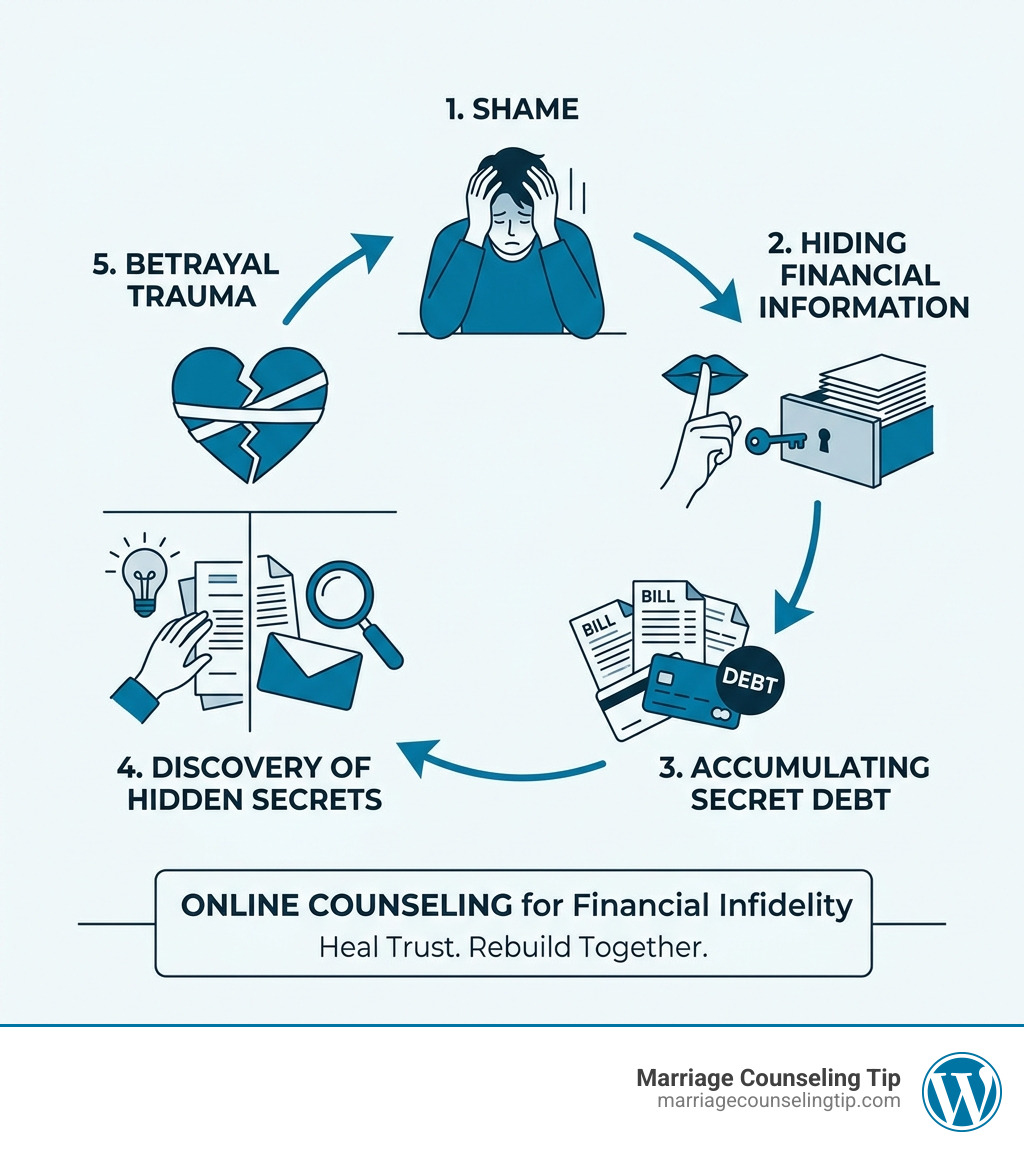
Understanding the Impact of Financial Infidelity
When we talk about “infidelity,” our minds usually jump to physical affairs. However, for many of us, a secret bank account can feel just as devastating as a secret lover. This is often referred to as betrayal trauma. When the person you trust most in the world hides significant financial activity, it shatters the foundation of emotional safety in the relationship.
Financial infidelity takes many forms. It might be a partner hiding the price of $180 sunglasses to avoid judgment, or it could be a massive betrayal like an $80,000 student loan kept secret for years. Sometimes, it involves “marital financial deception” (MFD), where one spouse drains a child’s college fund or takes out secret loans in the other spouse’s name.
The emotional toll is heavy. Betrayed partners often experience:
- Hypervigilance: Constantly checking the mail or bank apps.
- Anxiety: Worrying about the family’s future stability.
- Resentment: Feeling like a “parent” or “police officer” in the relationship.
- Isolation: Feeling unable to share the crisis with friends or family due to shame.
Is this behavior actually “wrong”? We explore this deeply in our guide on Is Hiding Money from Your Spouse Wrong?. While some argue for financial autonomy, intentional deception in a partnership where resources are combined is a breach of the marital contract.
| Psychological Effect | Financial Infidelity | Sexual Infidelity |
|---|---|---|
| Primary Emotion | Betrayal & Insecurity | Betrayal & Inadequacy |
| Trust Breakdown | Severe (Safety of the home) | Severe (Safety of the heart) |
| Long-term Stress | Legal/Credit Damage | Emotional/Relational Damage |
| Recovery Focus | Transparency & Math | Intimacy & Forgiveness |
According to recent data, 1 in 3 Americans believe hiding money is actually worse than physical cheating. This is because money represents our security, our future, and our ability to provide for our children. When that is compromised, the panic is visceral.
Why Professional Financial Infidelity Counseling is Essential
Healing from this isn’t as simple as “just being honest from now on.” The roots of financial secrecy are often buried deep in our past. We bring “money scripts” into our marriages—beliefs we learned as children about what money means. For some, money equals power; for others, it equals safety or even love.
Financial infidelity counseling is essential because it addresses the “why” behind the lies. A specialized therapist helps couples navigate:
- Root Causes: Was the secrecy born out of a fear of control? Did one partner grow up in a home where money was a source of conflict?
- Shame Cycles: The person hiding the money often feels intense shame, which leads to more hiding to “fix” the problem before it’s discovered.
- Power Dynamics: Sometimes, one partner has more financial “privilege” or earns more, leading the other to hide spending to reclaim a sense of autonomy.
If you’re unsure how to begin this process, we recommend following a Marriage Counseling for Infidelity: A Step-by-Step Roadmap. This structured approach ensures that you don’t just argue about the credit card bill, but actually rebuild the emotional safety needed to prevent it from happening again. Professional counseling provides a “financial ceasefire” where both partners can speak without the conversation devolving into the “Four Horsemen” of conflict: criticism, contempt, defensiveness, and stonewalling.
The Role of Mental Health and ADHD in Money Secrets
It is important to recognize that sometimes, financial infidelity isn’t driven by malice, but by untreated mental health conditions. Issues like Bipolar Disorder, Compulsive Shopping Disorder, and Gambling Addiction can lead to catastrophic financial wreckage.

When a partner is in a manic phase or struggling with an addiction, their impulse control vanishes. They may spend tens of thousands of dollars on pornography, risky investments, or luxury items, only to be met with crushing guilt later. This often leads to Lying to Your Spouse About How Much Money You Spent as a desperate attempt to keep the peace.
Addressing ADHD through Financial Infidelity Counseling
ADHD (Attention Deficit Hyperactivity Disorder) plays a surprisingly large role in many cases of financial secrecy. The core symptoms of ADHD—impulsivity, executive dysfunction, and poor long-term planning—can make managing a household budget feel impossible.
In an ADHD-affected marriage, the “non-ADHD” spouse often takes on a managerial role, which can lead to the ADHD spouse feeling “parented.” To escape this feeling, they might make impulse purchases and hide them to avoid a lecture. This is a classic “dopamine-seeking” behavior.
Through financial infidelity counseling, couples can learn to:
- Create accountability structures that don’t feel like “policing.”
- Understand that “forgetting” to mention a purchase isn’t always the same as a calculated lie, though the impact on trust is the same.
- Use tools like automated savings and “allowance” accounts to provide freedom while protecting the family’s core finances.
To understand the early stages of this therapeutic journey, check out our insights on Infidelity Therapy: What to Expect in the First Month.
Identifying Warning Signs of Financial Deceit
If you suspect your partner is hiding something, your “gut feeling” is often right. Common warning signs include:
- Defensiveness: Getting angry or “flipping the script” when you ask a simple question about a statement.
- Intercepted Mail: Your spouse insists on being the only one to check the mailbox or has changed statements to “paperless” without telling you.
- New Credit Cards: Finding mail from banks you don’t do business with.
- Unexplained Withdrawals: Large sums of cash leaving joint accounts without a clear purpose.
- Sudden Lifestyle Changes: New clothes or gadgets appearing without a corresponding “win” at work.
Many people wonder, Is It OK to Hide Money from Your Spouse? under certain circumstances, like saving for a surprise or protecting oneself from an abusive partner. However, in a healthy, safe marriage, transparency is the gold standard.
Rebuilding Trust and Financial Transparency
The road to recovery requires a total commitment to “radical transparency.” You cannot fix what you do not acknowledge. In our experience, the most successful couples are those who treat the financial crisis as “us vs. the problem” rather than “me vs. you.”

Practical Steps in Financial Infidelity Counseling
During the counseling process, we often recommend several “re-entry” steps to stabilize the marriage:
- The Full Disclosure: Both partners bring every statement, login, and debt to the table. No more “trickle truth.”
- Money Meetings: Schedule a weekly “money date.” Keep it short (20 minutes), bring snacks, and review the week’s spending and the upcoming month’s goals.
- Joint Accounts vs. Individual Pots: Many counselors suggest a “three-pot” system: one joint account for household bills and two individual accounts for “no-questions-asked” personal spending.
- Password Sharing: In the wake of betrayal, privacy is often a luxury that must be earned back. Sharing passwords to bank accounts and credit card portals is a vital step in rebuilding safety.
- “I” Statements: Instead of saying “You ruined our credit,” try “I feel terrified when I see our debt increasing because I value our family’s security.”
When deciding between a financial planner and a therapist, a planner handles the math, but a therapist handles the marriage. For more on the logistics, see Marriage Counseling for Couples: Goals, Costs, and Results.
For those seeking specialized help, there are excellent resources available. You might consider Financial Infidelity Therapy with Debra Kaplan, who specializes in the intersection of sex addiction and financial betrayal, or explore Treatment for Financial Infidelity at Koru Financial Therapy, which offers nature-based and online options for California residents.
Frequently Asked Questions about Money Lies
How long does recovery from financial betrayal typically take?
Recovery is not a sprint; it’s a marathon. While some couples see a “stabilization” of their finances within a few months, rebuilding the emotional trust typically takes 12 to 24 months of consistent honesty. It requires the betraying partner to be patient with the betrayed partner’s hypervigilance and for both to commit to professional guidance. You can learn more about rebuilding trust after financial secrecy through dedicated couples therapy.
Can counseling save a marriage after secret bankruptcy?
Yes. Secret bankruptcy is a “level ten” betrayal, but it doesn’t have to be the end. Counseling in this scenario acts as crisis intervention. It helps the couple navigate the legal stress and the shame of the situation while creating a “future-focused” plan. Many couples find that after the “secret” is out, they can finally breathe and work together to overcome financial infidelity in marriage.
Is hiding money from a spouse considered a sin?
For many of our readers, the spiritual dimension is just as important as the psychological one. Many religious traditions view marriage as a “one flesh” union, meaning that total honesty is a spiritual requirement. We dive into the moral and religious implications in our article: Is Hiding Money from Your Spouse a Sin?. Regardless of your faith, most agree that a marriage cannot thrive on a foundation of lies.
Conclusion
At Marriage Counseling Tip, we know that financial secrets are rarely just about the money. They are about fear, shame, and a breakdown in communication. But there is a way back. Whether you are dealing with a partner’s impulsive spending or you’ve discovered a mountain of hidden IRS debt, you don’t have to face it alone.
We specialize in helping couples navigate the complex intersection of relationship therapy and financial recovery. If your spouse’s actions have left you with unexpected tax liabilities, we can guide you through innocent spouse relief and other legal protections to ensure your future isn’t ruined by someone else’s mistakes.
Financial infidelity counseling can save your marriage by turning a crisis into an opportunity for deeper intimacy and true partnership. Don’t wait for the next “surprise” statement to arrive. Rebuild your future today and start the journey toward a transparent, secure, and loving marriage.
Additional Resources for Healing: