
Married Filing Jointly vs. Separately: How to Choose Your Winner
Does Filing Separately or Jointly Which Is Better Actually Matter for Your Marriage’s Finances?
Filing separately or jointly which is better depends on your specific situation — but here’s the short answer most couples need:
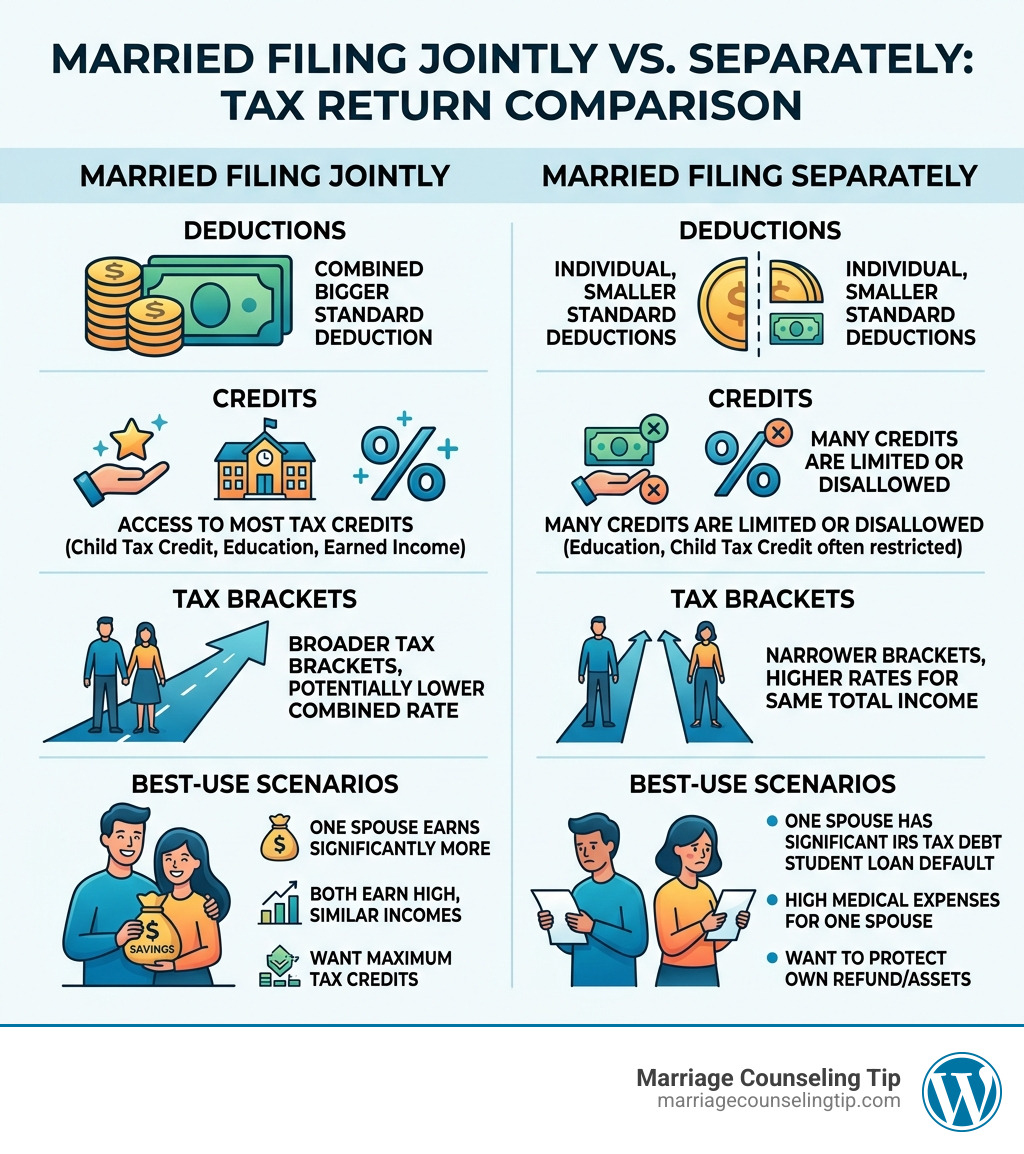
Quick Answer: Joint vs. Separate Filing
| Situation | Best Choice |
|---|---|
| One spouse earns significantly more | Married Filing Jointly |
| Both spouses earn high, similar incomes | Consider Separately |
| One spouse has IRS tax debt or student loans | Married Filing Separately |
| High medical expenses for one spouse | Married Filing Separately |
| Want access to most tax credits | Married Filing Jointly |
| Preparing for divorce or protecting assets | Married Filing Separately |
For most couples, filing jointly saves money. About 95% of married couples — roughly 55 million — file jointly each year. The bigger standard deduction ($31,500 joint vs. $15,750 each separately in 2025) alone makes it the winner in most cases.
But “most couples” isn’t your couple.
If your spouse has IRS back taxes, defaulted loans, or financial secrets you’re only now discovering, filing jointly could put your refund — and potentially your assets — at serious risk. That changes everything.
This guide breaks down exactly when each filing status wins, so you can protect yourself and make the smartest financial decision for your marriage.
Understanding the Basics: Married Filing Jointly vs. Separately
When we sit down to tackle our taxes in April 2026, the first big hurdle is clicking that little box for “Filing Status.” It seems like a small detail, but it’s the foundation of your entire tax return. It determines your tax brackets, your standard deduction, and which credits you can actually pocket.
The IRS generally looks at your marital status on the very last day of the year. If you were legally married on December 31, the IRS considers you married for the entire year. From there, you have two primary paths: Married Filing Jointly (MFJ) or Married Filing Separately (MFS).
The biggest difference often comes down to the standard deduction. This is the “freebie” amount the IRS lets you subtract from your income before they start taking their cut. For the 2025 tax year (which we are filing for now in early 2026), the numbers have shifted upward to keep up with inflation.
| Filing Status | 2025 Standard Deduction | 2026 Standard Deduction (Est.) |
|---|---|---|
| Married Filing Jointly | $31,500 | $32,200 |
| Married Filing Separately | $15,750 | $16,100 |
As you can see, filing jointly gives you exactly double the deduction of a separate filer. However, it’s not just about the deduction. Tax brackets are also wider for joint filers. For example, the 10% tax rate applies to the first $23,850 of income for joint filers, but only the first $11,925 for those filing separately.
Choosing between the two requires looking at your combined income versus your individual earnings. You can find more detailed breakdowns of these nuances in this guide on Married Filing Jointly Vs. Separately: Which Is Better for You?.
Can married couples file as single?
We often get asked if a married couple can simply choose to file as “Single” to keep things easy. The short answer is: No. If you are legally married, you must choose a married filing status.
There are only a few rare exceptions. If you have a legal separation decree or a divorce decree that was finalized by December 31, you are considered unmarried. Additionally, if you lived apart from your spouse for the last six months of the year and provided a home for a qualifying dependent, you might be eligible for “Head of Household” status, which offers better rates than filing separately.
Understanding these boundaries is vital for IRS compliance. For a deeper dive into the legalities of whether you are forced to file together, check out our resource: Do you have to file your taxes together as a married couple?
When Married Filing Jointly is the Clear Winner
There is a reason why 95% of the 55 million married couples in the U.S. choose to file jointly. In the eyes of the IRS, a joint return is the “default” for a reason—it usually results in the lowest total tax bill.
Income Disparity is the Big Driver If one spouse earns $100,000 and the other earns $10,000 (or stays at home), filing jointly is almost always the winner. Why? Because the higher earner’s income gets “pulled down” into the lower tax brackets of the lower-earning spouse. This “tax bracket expansion” can save couples thousands of dollars compared to filing separately, where the high earner would be hammered by higher marginal rates.
Capital Loss Limits If you had a rough year in the stock market, filing jointly allows you to deduct up to $3,000 in net capital losses against your ordinary income. If you file separately, that limit is chopped in half to $1,500 per person.
Simplicity and Trust Filing jointly is simpler. You file one return, pay one fee to your tax preparer, and deal with one set of documents. However, it requires a high level of financial trust, as both spouses are “jointly and severally liable” for everything on that return. You can read more about the benefits of filing jointly to see if these perks outweigh the risks for your household.
Filing separately or jointly which is better for specific financial hurdles?
While joint filing is the popular kid in class, there are several “niche” scenarios where filing separately is actually the smarter financial move. This is where we have to put on our detective hats and look at the fine print of your expenses.

The 7.5% Medical Threshold One of the most common reasons to file separately involves high medical expenses. The IRS allows you to deduct medical costs that exceed 7.5% of your Adjusted Gross Income (AGI).
Imagine Spouse A earns $50,000 and has $10,000 in medical bills.
- If filing separately: 7.5% of $50,000 is $3,750. Spouse A can deduct $6,250 ($10,000 – $3,750).
- If filing jointly: If Spouse B also earns $100,000, their combined AGI is $150,000. Now, the 7.5% threshold jumps to $11,250. Since the medical bills ($10,000) don’t even reach that threshold, the couple gets zero deduction.
In this case, filing separately “lowers the bar” for the deduction.
SALT and Itemization Rules A major “gotcha” for separate filers is that you must be consistent. If one spouse chooses to itemize deductions (like mortgage interest or state and local taxes), the other spouse must also itemize—even if their itemized deductions are $0. They cannot take the standard deduction. This can lead to a much higher tax bill for one spouse, so you have to run the numbers for both of you combined.
Furthermore, the State and Local Tax (SALT) deduction, which is capped at $10,000 for joint filers, is halved to $5,000 each for separate filers. If you’re wondering which path to take, we’ve analyzed this further here: Is it better to file taxes married jointly or married separately?
Filing separately or jointly which is better for student loan borrowers?
For many of us, student loans are the biggest monthly expense after the mortgage. If you are on an Income-Driven Repayment (IDR) plan, your monthly payment is calculated based on your AGI.
When you file jointly, the loan servicer looks at your combined income. If your spouse is a high earner, your “affordable” student loan payment could skyrocket to a level that feels anything but affordable. By filing separately, the servicer generally only looks at your individual AGI, which can significantly lower your monthly payment.
This is especially critical for those pursuing Public Service Loan Forgiveness (PSLF). Lowering your monthly payment while you wait for that 10-year forgiveness mark can save you tens of thousands of dollars over the life of the loan. However, you have to weigh this against the fact that you’ll likely pay more in federal income tax by filing separately. It’s a classic “math-off.” You can find more on this strategy in this CNBC guide for 2026 filers.
Filing separately or jointly which is better when one spouse has tax debt?
This is where the “Counseling” in Marriage Counseling Tip really comes into play. Money issues are often a symptom of deeper marital strain, and nothing causes strain quite like a surprise IRS notice.
If one spouse has significant IRS back taxes, defaulted student loans, or unpaid child support from a previous relationship, the IRS can seize a joint tax refund to pay those debts. This is called an “offset.”
If you file separately, you protect your own refund from being snatched to pay for your spouse’s past mistakes. While “Injured Spouse Relief” is an option for joint filers, it involves a lot of paperwork and waiting. Filing separately is a cleaner “firewall” between your finances and their debt.
If you are dealing with a spouse who has been less than honest about their tax history—a form of financial infidelity—filing separately is a vital step in protecting your financial future. We discuss the specifics of this protective measure here: Should I file separately if my husband owes taxes?
The Hidden Costs: Credits and Deductions You Might Lose
Before you commit to filing separately, we need to talk about the “penalty” box. The IRS doesn’t really like it when married people file separately (they suspect people are trying to “game” the system), so they take away a lot of the best tax “goodies.”

When you file separately, you are generally disqualified from:
- Earned Income Tax Credit (EITC): A huge credit for low-to-moderate-income working families.
- Child and Dependent Care Credit: Money back for daycare expenses.
- Education Credits: The American Opportunity Credit and the Lifetime Learning Credit are usually off-limits.
- Student Loan Interest Deduction: You cannot deduct the interest you paid on your loans if you file separately.
The Roth IRA Trap This is the one that catches many people off guard. If you live with your spouse and file separately, your ability to contribute to a Roth IRA starts to phase out if your income is just $10,000. Compare that to the 2025 joint filing phase-out, which starts around $230,000. If you earn a normal salary and file separately, you likely cannot contribute to a Roth IRA at all.
For a full list of these “lost” benefits, Bankrate provides an excellent breakdown of what you’re giving up.
How to Decide: Running the Numbers and Amending Returns
So, how do we actually decide? Don’t guess. In the age of 2026 tax technology, there’s no reason to leave this to chance.
- Run Dual Scenarios: Most modern tax software allows you to “mock up” your return both ways. Enter your data as a joint couple, then try it as two separate filers. Compare the “Bottom Line” (Total Tax Owed) for both scenarios.
- Consider the “Debt Factor”: If the joint return saves you $2,000 in taxes, but the IRS is going to seize your $5,000 refund to pay your spouse’s old debt, the “separate” filing might still be the winner for you personally.
- Consult a Pro: If you have business income, rental properties, or live in a community property state (like California or Texas), the rules for splitting income are incredibly complex. A tax professional is worth their weight in gold here.
Can you change your mind? The IRS is surprisingly forgiving if you want to switch from Separate to Joint. You generally have a three-year window from the original filing deadline to file an amended return (Form 1040-X) and change your status to “Jointly.” This is great if you realize later that you missed out on big credits.
However, the reverse is not true. Once you file a joint return and the tax deadline passes, you generally cannot switch back to “Separate” for that tax year. The IRS views a joint return as a binding legal contract between you, your spouse, and the government.
Frequently Asked Questions about Filing Status
Can we switch from filing separately to jointly after the deadline?
Yes! As mentioned above, if you realize that filing separately cost you too much money, you have three years to file an amended return and switch to a joint status. This often happens when couples realize they missed out on education or child care credits.
What happens if one spouse wants to itemize and the other doesn’t?
This is a recipe for a kitchen-table argument. If you file separately, you must both do the same thing. If your spouse itemizes their $20,000 in mortgage interest, you are forced to itemize your deductions as well. If you have no deductions to claim, your deduction is effectively $0, which is a huge loss compared to the $15,750 standard deduction you could have had.
Does filing separately protect me from my spouse’s tax fraud?
Yes. When you sign a joint return, you are legally responsible for every number on that page—even the ones your spouse might have lied about. If the IRS discovers fraud later, they can come after your wages and your bank account. Filing separately keeps your legal and financial liability entirely separate. If you’ve already filed jointly and discovered issues, you may need to look into “Innocent Spouse Relief,” which is a complex legal process to untangle your liability.
Conclusion
At the end of the day, filing separately or jointly which is better isn’t just a math problem—it’s a reflection of your relationship’s health and your financial goals. While the IRS gives a “marriage bonus” to most couples who file together, that bonus isn’t worth it if it compromises your financial safety or peace of mind.
At Marriage Counseling Tip, we specialize in helping couples navigate the messy intersection of taxes and trust. Whether you are dealing with the fallout of financial infidelity, struggling with a spouse’s IRS back taxes, or just trying to figure out how to protect your future, we are here to help.
Tax season doesn’t have to be a source of marital strife. By running the numbers, being transparent about debts, and choosing the filing status that offers the best protection, you can turn a stressful April deadline into a moment of financial clarity for your partnership.