
In the days after discovering an affair, most couples are not looking for “deep relationship work” yet. They are looking for stability. They want the panic to stop, the questions to slow down, and a plan that makes the next 24 hours feel survivable.
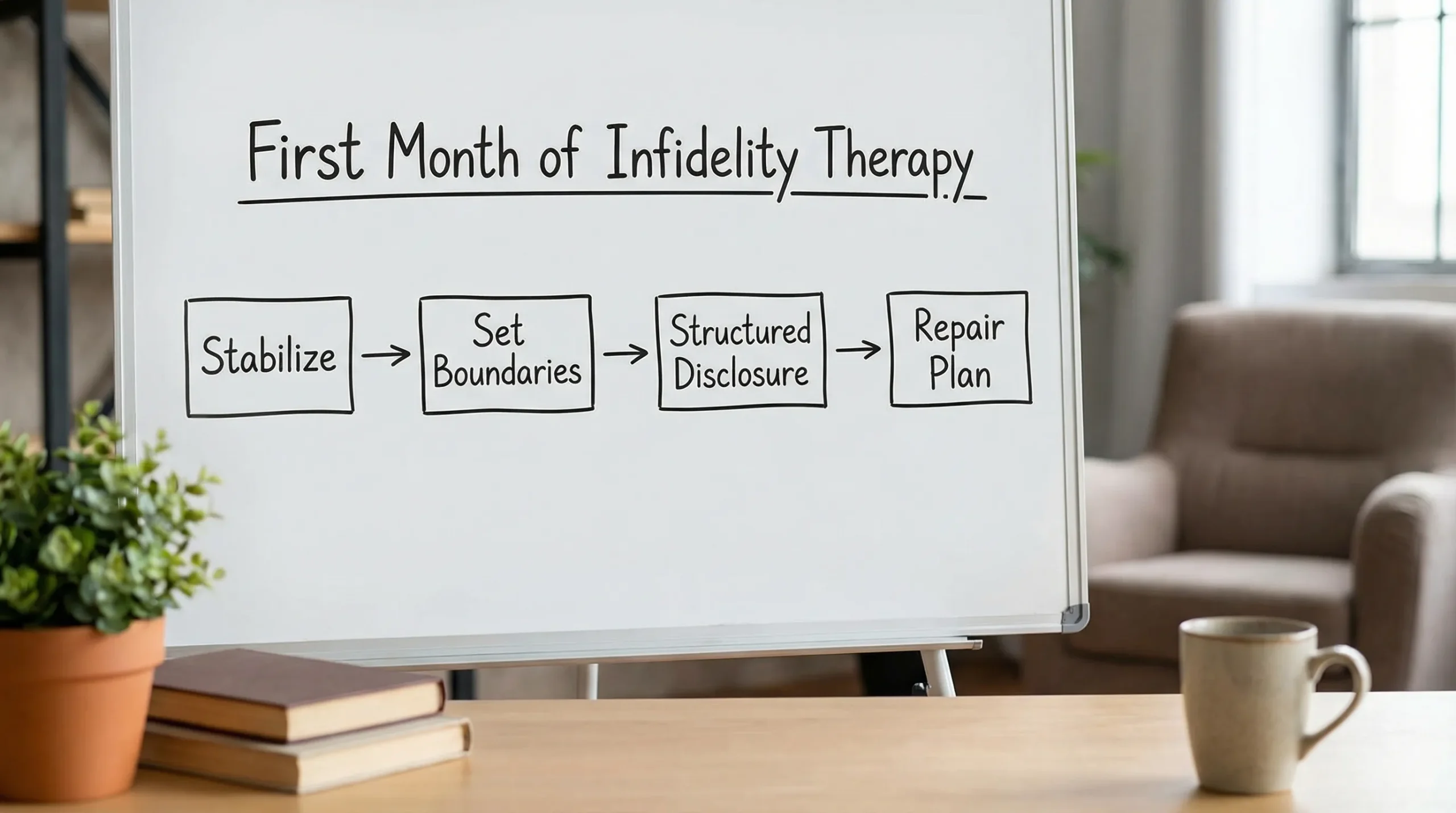
That is exactly what infidelity therapy is often designed to do in the first month: help you contain the crisis, establish emotional and practical safety, and create a structured path forward, whether you ultimately reconcile or separate.
Below is what you can typically expect in the first four weeks, what a qualified therapist is trying to accomplish (and what they are not trying to do yet), plus how to prepare so you do not lose momentum between sessions.
What “infidelity therapy” usually means (and what it is not)
Infidelity therapy is not a single technique. It is couples therapy that focuses on the fallout of betrayal (sexual, emotional, online, and often financial) and helps partners:
- Stabilize intense emotions and reduce destructive conflict
- Clarify what happened enough to stop ongoing harm
- Rebuild trust through consistent, observable behavior
- Decide, over time, whether to repair the relationship and how
Different clinicians use different frameworks. Common evidence-informed approaches include Emotionally Focused Therapy (EFT) and Gottman Method Couples Therapy, among others. The model matters less in week one than whether the therapist can keep you both safe, grounded, and moving toward clear agreements.
If you are new to therapy, the American Psychological Association’s overview of psychotherapy is a helpful orientation to what therapy is supposed to look like (collaborative, goal-based, and confidential with standard safety exceptions).
The goal of the first month: stabilize first, then start rebuilding
Many couples expect the first month to answer the big question: “Can we recover?” In practice, month one is usually about answering smaller questions that make recovery possible:
- Can we talk about what happened without escalating into screaming, shutdown, or threats?
- Can we stop the bleeding (ongoing contact, trickle-truth, retaliation, digital spying spirals)?
- Can we agree on basic boundaries and transparency so both partners can sleep and function?
- Can we create a plan for the next 2 to 4 weeks that reduces chaos?
This phase often feels unglamorous, because it is more like emotional first aid than romance. That is normal.
Before the first session: how to prepare (without building a courtroom case)
If you can, do three things before your first appointment.
1) Write down what you need from therapy in one paragraph
Keep it concrete. Examples:
- “We need help talking about the affair without spiraling, and we need boundaries about contact with the other person.”
- “We need a structured disclosure process because the uncertainty is making me panic.”
- “We need to address financial secrecy connected to the affair (spending, hidden accounts, debt).”
2) Decide what “stability” would look like for the next two weeks
Not forever, just the next two weeks. For example: sleeping in separate rooms, no alcohol during conflict talks, daily check-in time limits, or childcare coverage for sessions.
3) Gather basic facts if financial infidelity is part of the story
Marriage recovery often stalls when money details remain foggy. If relevant, bring what you already have (no need to obsessively investigate):
- Recent bank and credit card statements
- Known debts and payment obligations
- A list of shared accounts and who has access
This is consistent with the mission of Marriage Counseling Tips: healing financial trauma alongside emotional betrayal, because the two frequently overlap.
What the first month often looks like (week by week)
Every therapist structures this differently, and some couples meet weekly while others start with twice-weekly sessions during the acute phase. Still, a “week-by-week” view can reduce anxiety.
| Timeframe | Primary focus | What you might feel | What the therapist is likely to do |
|---|---|---|---|
| Week 1 | Crisis stabilization and rules of engagement | Shock, rage, numbness, obsession, shame | Set session structure, stop escalations, clarify immediate safety needs, discuss boundaries and contact, screen for risk |
| Week 2 | Assessment and containment | Urgency for details, fear of being manipulated, defensiveness | Map relationship history, identify triggers, define transparency agreements, begin disclosure planning |
| Week 3 | Meaning-making and early trust behaviors | Grief, anger waves, “Is any of this real?” | Teach repair conversations, address accountability, build empathy without excusing, set consistency practices |
| Week 4 | A workable recovery plan | Cautious hope, exhaustion, impatience | Establish goals, decide on frequency, coordinate individual therapy if needed, track progress markers |
Week 1: “Stop the bleeding” and create emotional safety
In the first sessions, a skilled infidelity therapist is usually prioritizing stabilization over storytelling.
Expect the therapist to slow you down and set ground rules such as:
- No interrupting, name-calling, or threats during session
- Time-limited “affair talk” at home (so it does not consume every hour)
- A plan for what to do when one person gets flooded (pause, breathe, separate, return)
If there is any concern about coercion, intimidation, or violence, the therapist should address safety directly and may recommend individual sessions, additional resources, or a different level of care.
What about the “whole story” in week 1?
Many betrayed partners want every detail immediately, because uncertainty is genuinely destabilizing. Many participating partners want to “move on” quickly, or they fear that more details will make things worse.
In the first week, therapy often aims for:
- Enough clarity to stop ongoing harm (for example, whether the affair is ongoing)
- Agreements that reduce re-traumatization (for example, no late-night interrogations)
- A plan for disclosure that is structured, paced, and not done in a chaotic fight
Some therapists use a formal “therapeutic disclosure” process, especially when there has been prolonged deception or compulsive sexual behavior. Others keep it simpler. The common thread is this: unstructured disclosure can cause additional trauma, even when the truth is necessary.

Week 2: assessment, boundaries, and the first trust-building agreements
Week 2 often includes more assessment. The therapist may ask about:
- The relationship timeline (before and after the betrayal)
- Prior ruptures and repairs
- Attachment patterns (pursue, withdraw, freeze)
- Mental health history (depression, anxiety, trauma)
- Substance use
- Financial stressors (debt, hidden spending, income disparity)
This is also when many couples create their first behavior-based trust agreements, such as:
- A no-contact boundary with the affair partner (and what “contact” includes)
- Transparency around phones and social media for a defined period (and how to avoid turning it into 24/7 policing)
- Location sharing, calendar access, or check-in routines
- Financial transparency steps (shared view-only access, spending disclosures, a temporary spending cap)
These are not meant to be permanent surveillance. In recovery, transparency is usually framed as a temporary scaffolding that supports nervous system safety until trust is rebuilt through consistency.
If you want to understand the training background of couples therapists, the American Association for Marriage and Family Therapy outlines what marriage and family therapists do and how the profession is structured.
Week 3: shifting from “facts” to impact, accountability, and repair
By week 3, many couples hit a painful milestone: the initial adrenaline fades, and the grief sets in. This is often when partners realize that even if they stay together, the relationship will not go back to “before.”
Infidelity therapy commonly starts focusing on three parallel tracks:
1) Impact: what this did to the betrayed partner
This is not just sadness. Betrayal can mirror trauma responses: intrusive thoughts, hypervigilance, sleep disruption, appetite changes, and a constant scanning for danger. A good therapist helps name these responses and builds coping plans.
2) Accountability: what the participating partner must do consistently
Accountability is more than saying sorry. In therapy it often includes:
- Ending all deception (including “small” omissions)
- Answering questions in a planned, non-defensive format
- Demonstrating empathy for the partner’s pain
- Accepting reasonable transparency without resentment
- Repairing practical harms (including financial harms)
3) Relationship patterns: what made the relationship vulnerable (without blaming the betrayed partner)
This part is delicate. The therapist should never imply that the betrayed partner “caused” the betrayal. At the same time, if the couple is trying to rebuild, they will eventually examine disconnection patterns, conflict avoidance, sexual issues, money stress, or loneliness that existed before the affair.
Some couples find it useful to read about staged recovery models such as the Gottman approach (often summarized as “Atone, Attune, Attach”). If you explore that framework, use it as a map, not as a scorecard. For an overview, see the Gottman Institute’s writings on healing from affairs.
Week 4: a realistic plan, plus decisions about next steps
By week 4, your therapist is usually trying to prevent a common failure point: couples who come in during crisis, feel slightly better, and then stop too early.
Expect a shift toward:
- A treatment plan (goals, frequency, what “progress” will look like)
- Coordination with individual therapy when needed (trauma, depression, compulsive behaviors)
- Clear expectations for continued transparency and repair
- Communication structures that lower conflict intensity
This is also the time when the question “Are we staying together?” often becomes louder. Many therapists encourage couples not to force a final decision in the peak of emotional flooding. Instead, you might agree to a stabilization window (for example, 60 to 90 days) with defined rules, then re-evaluate.
Common “homework” in the first month (and why it matters)
Therapy is rarely just the 50 minutes in the room. In month one, homework is usually about reducing chaos and increasing predictability.
You might be asked to try:
- A daily 10 to 20 minute check-in with a timer (stop when time is up)
- A trigger plan (what the betrayed partner does when flooded, what the participating partner does in response)
- A written transparency agreement (devices, schedules, spending)
- A weekly money meeting if financial secrecy is part of the rupture
If money is part of the betrayal, consider adding a “financial stabilization” checklist for the first month:
| Area | Stabilizing step (temporary) | Purpose |
|---|---|---|
| Accounts | Shared view-only access to key accounts | Reduce panic and stop new secrecy |
| Spending | A short-term spending cap or dual approval threshold | Prevent further harm while emotions are high |
| Debt | A list of all known debts and minimum payments | Replace uncertainty with facts |
| Documentation | Save statements and receipts related to the betrayal | Support repair and, if needed, legal clarity |
(For legal questions, it is often wise to consult a licensed attorney in your state. A therapist can help you emotionally, but should not replace legal advice.)
What is normal to feel in month one (and what is a warning sign)
Normal (even if it is miserable)
- Rapid mood swings
- Wanting closeness one hour and distance the next
- Obsessive thought loops and “mental movies”
- Arguments that start from small triggers
- A sense that time has slowed down
Warning signs that require a different approach
Infidelity therapy should not feel like punishment, and it should not feel like uncontrolled chaos either. Consider adjusting the plan (or changing clinicians) if:
- Sessions repeatedly escalate with no structure and no de-escalation tools
- The therapist pressures quick forgiveness or minimizes the betrayal
- The therapist allows blaming the betrayed partner for the affair
- There is ongoing deception and the therapist does not address it directly
- There are safety concerns (threats, stalking behaviors, coercion) that are not taken seriously
If anyone is in immediate danger, contact local emergency services. If you are in the US and need 24/7 support, you can call or text the 988 Suicide & Crisis Lifeline.
How to get the most out of infidelity therapy in the first month
A few practical moves can make early therapy dramatically more effective.
Use therapy to create agreements, not to “win”
Your therapist is not a judge. If you approach session like cross-examination, you can end up with more information but less safety. Aim for agreements that reduce harm this week.
Track behaviors, not promises
In early recovery, trust rebuilds from repeatable actions: consistent transparency, empathy without defensiveness, and follow-through on boundaries.
Protect the rest of your life while you are healing
Month one can swallow everything. If you can, set guardrails (sleep, food, work commitments, childcare). Stabilizing your nervous system is not avoidance, it is what makes constructive conversations possible.
A final note on expectations
Many couples secretly hope that a therapist will tell them, in the first month, whether their marriage is salvageable. The more realistic outcome is this: by the end of month one, you should feel that the situation is no longer free-falling.
You may still be in pain, but you should have:
- Clearer boundaries
- A workable structure for hard conversations
- A transparency plan (including financial transparency if relevant)
- A sense of what each partner must do next
If that is happening, the first month is doing its job.
For more guidance on rebuilding trust after deception that includes money secrecy, explore the resources at Marriage Counseling Tips.