
10 Common Myths About Tax Brackets Married Filing Separately
What Are the Tax Brackets for Married Filing Separately? (Quick Answer)
Tax brackets for married filing separately determine how much federal income tax you owe when you and your spouse each file your own return instead of a joint one.
Here are the 2025 and 2026 federal income tax brackets for Married Filing Separately (MFS):
| Tax Rate | 2025 MFS Income Range | 2026 MFS Income Range |
|---|---|---|
| 10% | $0 – $11,925 | $0 – $12,400 |
| 12% | $11,926 – $48,475 | $12,401 – $50,400 |
| 22% | $48,476 – $103,350 | $50,401 – $105,700 |
| 24% | $103,351 – $197,300 | $105,701 – $201,775 |
| 32% | $197,301 – $250,525 | $201,776 – $256,225 |
| 35% | $250,526 – $375,800 | $256,226 – $384,350 |
| 37% | Over $375,800 | Over $384,350 |
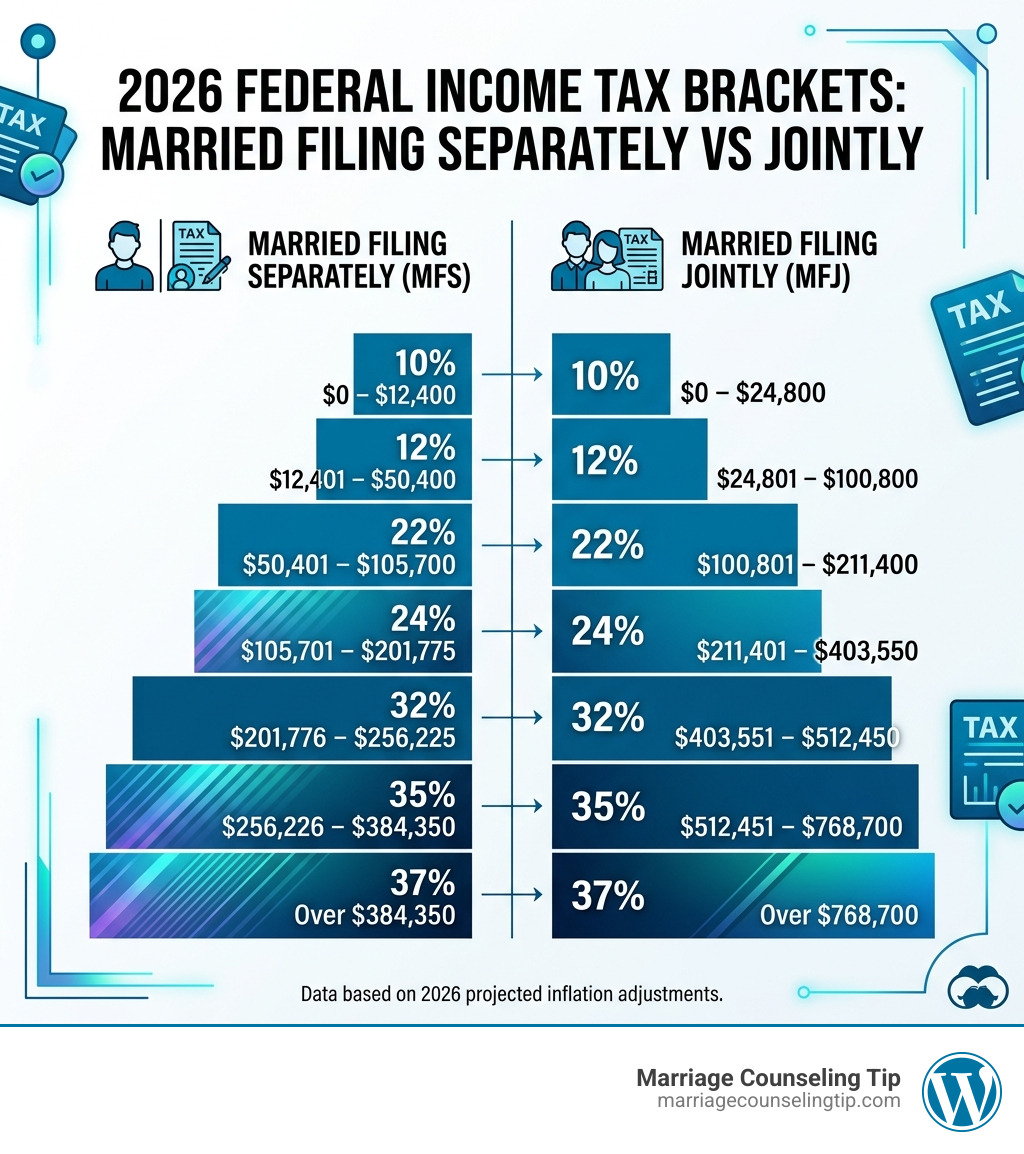
Key point: The 37% top rate kicks in at roughly half the income threshold compared to Married Filing Jointly (MFJ), where the 37% rate doesn’t start until over $751,600 (2025) or $768,700 (2026).
If your spouse owes back taxes to the IRS, you may be reading this in a panic — and that makes complete sense. The fear of being held responsible for a debt you didn’t create is real, and it can feel overwhelming.
But here’s the thing: there is a lot of misinformation out there about how the MFS filing status actually works, what it costs you in taxes, and what it can (or can’t) protect you from.
Many people assume filing separately means paying more, losing all credits, or that it offers no real financial protection. Some of those beliefs are myths. Others contain partial truths that depend heavily on your specific situation.
This guide breaks down 10 of the most common myths about MFS tax brackets — so you can make a smarter, more informed decision about how to file.
Myth 1: Tax Brackets for Married Filing Separately Are Identical to Single Filers
It is a very common misconception that if you choose to file separately, you simply “become” a single filer in the eyes of the IRS. While there are similarities, especially in the lower rungs of the ladder, the tax brackets for married filing separately have their own unique ceilings that can catch high earners off guard.
In 2025 and 2026, the tax system remains progressive, meaning you pay tax in layers. For the lower brackets (10%, 12%, 22%, and 24%), the income thresholds for MFS filers do indeed mirror those of Single filers. However, once you reach the 35% and 37% rates, the “marriage penalty” often kicks in for separate filers.
For example, in the 2026 tax year, a Single filer doesn’t hit the 37% top marginal rate until their income exceeds $640,600. However, a person using the tax brackets for married filing separately hits that same 37% wall at just $384,351. This is exactly half of the threshold for Married Filing Jointly ($768,701).
The IRS uses “inflation indexing” to adjust these numbers every year. By using the Chained Consumer Price Index (C-CPI), the government tries to prevent “bracket creep”—a situation where inflation pushes you into a higher tax bracket even though your actual purchasing power hasn’t increased.
Understanding the 2026 Tax Brackets for Married Filing Separately
As we navigate through April 2026, it’s vital to look at the current numbers provided by the Tax Foundation. The 2026 system consists of seven progressive rates:
- 10% Rate: Applies to the first $12,400 of taxable income.
- 12% Rate: Applies to income between $12,401 and $50,400.
- 22% Rate: Applies to income between $50,401 and $105,700.
- 24% Rate: Applies to income between $105,701 and $201,775.
- 32% Rate: Applies to income between $201,776 and $256,225.
- 35% Rate: Applies to income between $256,226 and $384,350.
- 37% Rate: Applies to any taxable income over $384,350.

Myth 2: You Can Choose Different Deduction Methods Independently
We often hear couples say, “I’ll take the standard deduction, and my spouse will itemize their medical bills.” Unfortunately, the IRS has a “consistency requirement” that puts a stop to this.
If you file separately, you and your spouse must both choose the same method. If one spouse itemizes deductions (claiming specific expenses like mortgage interest or charitable contributions), the other spouse is forced to itemize as well—even if their own itemized deductions total $0. This often results in one spouse paying significantly more because they lose the benefit of the standard deduction.
For the 2025 tax year, the standard deduction for MFS is $15,750. By 2026, this is projected to rise to $16,100. If you are over 65 or blind, you may be eligible for an additional $1,600. However, remember the SALT (State and Local Tax) limit: even when filing separately, your deduction for state and local taxes is capped at $5,000 each (half of the $10,000 joint limit). You can find more detailed thresholds on taxformcalculator.com.
Calculating Taxable Income Within Tax Brackets for Married Filing Separately
To figure out which bracket you fall into, you must first calculate your taxable income. This isn’t just your salary; it’s your gross income minus “adjustments” (like certain retirement contributions) to reach your Adjusted Gross Income (AGI). From there, you subtract your deduction.
Many couples wonder, do you have to file your taxes together as a married couple? The answer is no, but the decision to go separate requires a careful look at how these deduction phase-outs affect your final “taxable” number.
Myth 3: Filing Separately Always Results in a Higher Tax Bill
While it’s true that many couples pay less by filing jointly, it is a myth that MFS is always more expensive. In fact, there are several scenarios where separate filing is the winning strategy.
If one spouse has very high out-of-pocket medical expenses, filing separately might be beneficial. Because medical deductions are only allowed for expenses that exceed 7.5% of your AGI, a lower individual AGI makes it easier to surpass that “floor” and actually claim the deduction.
Unequal incomes can also play a role. If one spouse earns significantly more, filing separately might push them into a higher marginal tax rate, but it might also protect the lower-earning spouse’s ability to claim certain income-based benefits.
Recent legislative updates, such as the OBBBA (One Billion Budget Balance Act) and the permanence of certain TCJA (Tax Cuts and Jobs Act) provisions, have adjusted how these brackets function, making the math more complex but sometimes more favorable for separate filers with specific debt or income profiles.

Myth 4: You Still Qualify for the Same Tax Credits
This is perhaps the most painful myth for families. When you choose to use the tax brackets for married filing separately, you lose eligibility for several of the most valuable tax credits offered by the IRS.
According to IRS guidelines, separate filers generally cannot claim:
- The Earned Income Tax Credit (EITC) (with very few exceptions for separated parents).
- The Child and Dependent Care Tax Credit (in most cases).
- The Adoption Tax Credit.
- Education credits like the American Opportunity Credit or the Lifetime Learning Credit.
Even the Child Tax Credit (CTC) is affected. While you can still claim it, the phase-out thresholds are much lower. For 2025 and 2026, the CTC begins to phase out at $200,000 of AGI for separate filers, compared to $400,000 for joint filers. Furthermore, you cannot deduct student loan interest if you file separately. If your financial plan relies on these credits, MFS could be a very costly choice.
Myth 5: Capital Gains Rates Are the Same as Joint Filers
Just like ordinary income, long-term capital gains and qualified dividends have their own brackets. Many people assume these rates are flat, but they are actually progressive: 0%, 15%, or 20%.
For 2025, the Tax Foundation notes that the 0% rate for separate filers applies only to taxable income up to $48,350. If you were filing jointly, that 0% window would extend all the way to $96,700.
If you have significant investments or plan to sell a property, filing separately could inadvertently push your capital gains into the 15% or 20% bracket much sooner than a joint return would. Additionally, the Net Investment Income Tax (NIIT) of 3.8% kicks in at an AGI of $125,000 for separate filers, compared to $250,000 for those filing jointly.
Myth 6: Filing Separately Doesn’t Protect You from a Spouse’s Debt
We saved the most important myth for last. In marriage counseling and financial infidelity, many spouses believe that once they are married, they are “stuck” with whatever tax mess their partner creates.
This is false. When you file a joint return, you assume “joint and several liability.” This means the IRS can come after you for 100% of the tax, interest, and penalties, even if your spouse earned all the money or committed the fraud.
By filing separately, you generally limit your liability to your own income and your own tax return. If you are asking, should I file separately if my husband owes taxes?, the answer is often a resounding “Yes” to protect your own refund and assets from being seized to pay his old debts.
At Marriage Counseling Tip, we specialize in helping couples navigate these waters. If you’ve discovered “back taxes” or secret debt, filing separately is a primary legal strategy to create a financial firewall. You may also be eligible for “Innocent Spouse Relief” if a joint return was already filed, but MFS is the proactive way to avoid the problem entirely.
Frequently Asked Questions about MFS Brackets
What is the 2026 top tax rate for married filing separately?
The top tax rate for 2026 is 37%. For those using the tax brackets for married filing separately, this rate applies to every dollar earned over $384,350. As a reminder, this threshold is exactly half of the $768,700 limit for joint filers. This progressive system ensures that as you move through each “layer” of income, you only pay the higher rate on the portion that falls within that specific bracket.
Can I deduct student loan interest if I file separately?
Generally, no. The IRS specifically disqualifies MFS filers from taking the student loan interest deduction. This is one of the “penalties” of filing separately. If you have significant student loan interest and your AGI is within the allowable limits for other statuses, you might find that filing separately costs you more in lost deductions than it saves you in liability protection.
How does inflation affect the tax brackets for married filing separately?
The IRS adjusts tax brackets annually to account for the rising cost of living. This is why the 10% bracket ends at $11,925 in 2025 but extends to $12,400 in 2026. These adjustments are designed to ensure that if you get a 3% raise that just barely covers inflation, you aren’t suddenly paying a higher percentage of your income in taxes. Comparing 2025 to 2026, you’ll see that every bracket threshold has shifted upward, providing a small amount of “breathing room” for taxpayers.
Conclusion
Navigating the tax brackets for married filing separately is about more than just numbers on a page; it’s about protecting your future and your peace of mind. While the MFS status often comes with higher rates and fewer credits, it remains a vital tool for spouses dealing with financial infidelity or a partner’s significant IRS debt.
Tax optimization is a key part of overall financial health. If you are struggling with the weight of tax debt or the stress of a spouse’s hidden financial history, don’t walk that path alone. For more info about marriage and tax debt services, explore our guides on innocent spouse relief and financial recovery. We are here to help you protect your assets and your relationship.