
Understanding the IRS Innocent Spouse Rule
When Your Spouse’s Tax Mistakes Become Your Problem
What is the innocent spouse relief? It is a legal provision under Internal Revenue Code § 6015 that allows you to be released from responsibility for extra taxes, penalties, and interest caused by errors your spouse made on a joint tax return — provided you had no knowledge of those errors and it would be unfair to hold you liable.
Here is a quick summary:
- What it covers: Understated taxes from your spouse’s unreported income, false deductions, or improper credits on a joint return
- Who it protects: The spouse who was unaware of the errors and did not significantly benefit from them
- How to apply: File IRS Form 8857
- Deadline: Generally within two years of the IRS first attempting to collect the debt
- Key requirement: You did not know — and had no reason to know — about the errors when you signed the return
When you file a joint tax return, the IRS holds both spouses fully responsible for everything on that return. Every dollar of tax. Every penalty. Every dollar of interest. This is called joint and several liability, and it does not go away after a divorce.
That means if your spouse underreported income, claimed fake deductions, or simply hid financial activity from you, the IRS can still come after you for the full amount owed.
This is financial infidelity at its most damaging. And it affects real people — couples who trusted each other, spouses who simply signed a return without knowing what was on it.
The innocent spouse relief rules exist precisely for this situation. They are not easy to qualify for — fewer than half of applications are granted based on the application alone — but they can be a critical lifeline when your financial future is on the line.
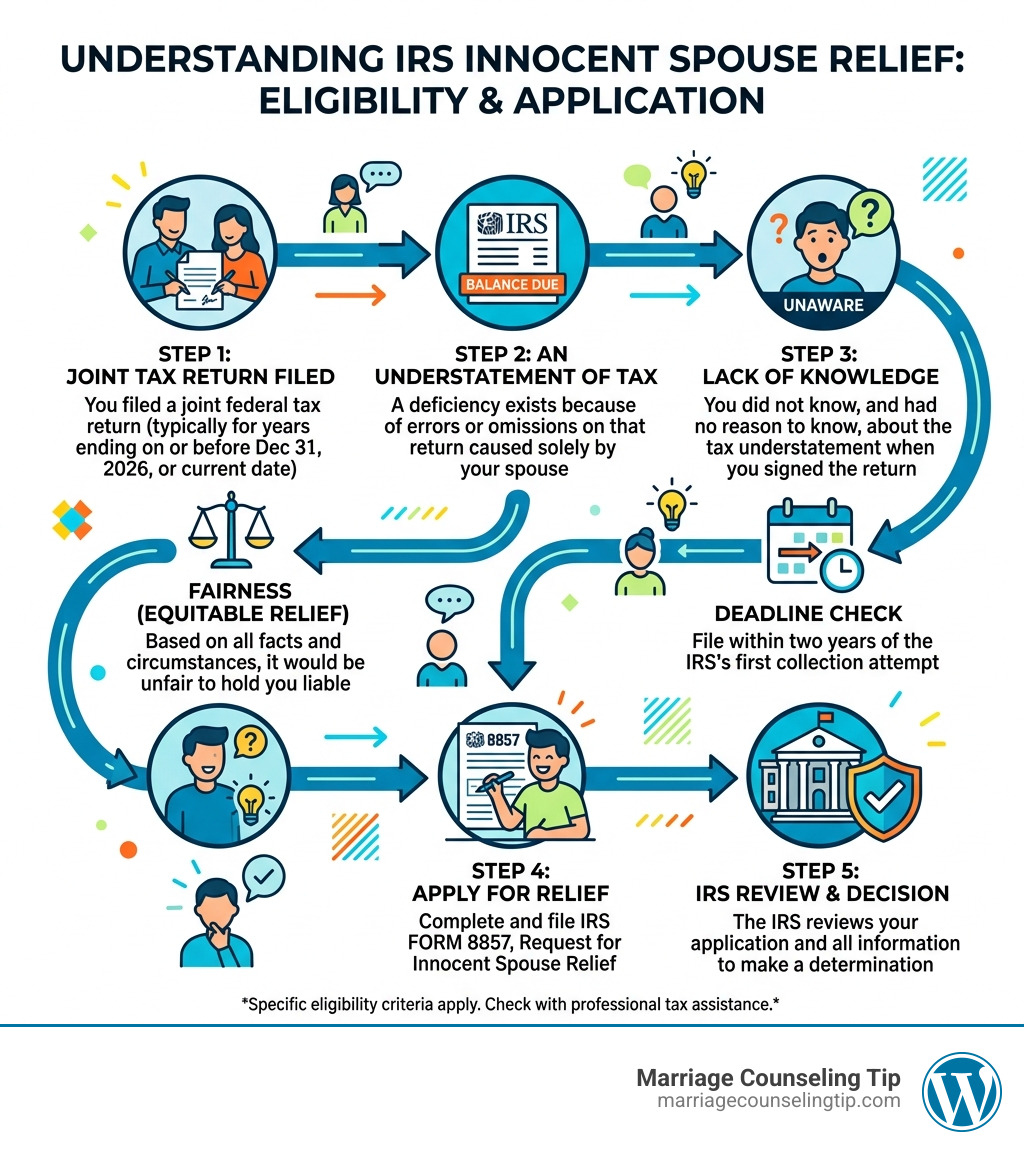
What is the Innocent Spouse Relief and How Does it Work?

At its core, what is the innocent spouse relief? It is an exception to the rule of joint and several liability. While the IRS usually doesn’t care who earned the money or who made the mistake, this relief acknowledges that it is fundamentally unfair to punish one spouse for the secret financial misdeeds of another.
When we talk about how this relief works, we have to look at how the IRS identifies a problem. Typically, this starts with an audit or a notice that the tax on your return was “understated.” This means the amount of tax shown on your return was less than the amount actually owed.
To qualify for relief, this understatement must be attributable to “erroneous items” belonging to your spouse. If the mistake was on your own income or your own business deductions, you cannot claim to be an innocent spouse for that portion of the debt.
The IRS review process is rigorous. They don’t just take your word for it; they look at your education, your involvement in the family finances, and whether your lifestyle matched the income reported on the return. You can learn more about the specifics in our guide on The Truth About Qualifying For Spousal Tax Relief.
Defining understated tax and erroneous items
To get a handle on what is the innocent spouse relief, you need to understand the technical terms the IRS uses:
- Understated Tax: This is the difference between the tax you should have paid and the tax you actually reported on your joint return. For example, if your return reported $5,000 in tax but an audit reveals you actually owed $7,000, that $2,000 difference is the understated tax.
- Erroneous Items: These are the specific mistakes that caused the understatement. They generally fall into two categories:
- Unreported Income: Money your spouse earned (like a side hustle or gambling winnings) that never made it onto the tax return.
- Incorrect Deductions, Credits, or Basis: This is when your spouse claims expenses that weren’t actually incurred, like $10,000 in “advertising” costs for a business that doesn’t exist, or claiming a child tax credit for a child who doesn’t live with you.
The impact of joint and several liability
Joint and several liability is a heavy legal concept. It means the IRS can legally collect the entire tax debt from either spouse. They don’t have to split it 50/50. If you have the savings and your ex-spouse has nothing, the IRS will likely come after you for 100% of the bill.
This liability follows you even after the ink is dry on your divorce papers. Even if your divorce decree says “Husband shall be responsible for all past tax debts,” the IRS is not bound by that private agreement. They can still place tax liens on your property or seize your future tax refunds to pay for your spouse’s old mistakes. This is why understanding innocent spouse relief is so vital for your financial survival.
The Four Types of Spousal Tax Relief
Not every situation fits into the same box. The IRS offers four distinct paths to relief, depending on your marital status and the nature of the tax debt.
| Relief Type | Best For… | Key Requirement |
|---|---|---|
| Classic Innocent Spouse | Couples still married or together | You had no “reason to know” of the error |
| Separation of Liability | Divorced or legally separated couples | Tax is split based on who earned what |
| Equitable Relief | Those who don’t fit the first two | It would be “unfair” to hold you liable |
| Injured Spouse Relief | Protecting your refund | Used for spouse’s past debts (student loans, child support) |
For a deeper dive into these categories, check out our article on What Are The Four Types Of Innocent Spouse Relief.
Key differences in what is the innocent spouse relief vs. injured spouse relief
People often confuse “Innocent Spouse” with “Injured Spouse,” but they are very different.
- Innocent Spouse Relief (Form 8857): This is for when there is an error or omission on a joint return that results in extra tax you didn’t know about. You are trying to get out of paying a debt caused by your spouse’s mistakes.
- Injured Spouse Relief (Form 8379): This is for when your joint refund is seized (offset) to pay for your spouse’s separate debts that existed before you were married, such as past-due child support or federal student loans. You aren’t saying the tax return was wrong; you’re just saying “Don’t take my half of the refund to pay his old debts.”
According to IRS Publication 971, these two forms of relief cannot be used interchangeably. If you file the wrong one, your request will likely be delayed or denied.
Separation of liability and equitable relief
If you are no longer married, Separation of Liability might be your best bet. This allows the IRS to essentially “undo” the joint return and calculate what you would have owed if you had filed separately. You are only held responsible for the tax allocated to your own income and deductions.
Equitable Relief is the “safety net.” If you don’t qualify for the other types—perhaps you actually did know about the error but were forced to sign the return under duress—the IRS can still grant relief if holding you liable would be “inequitable” (unfair). They look at factors like economic hardship and whether you received a “significant benefit” from the unpaid taxes.
Eligibility and the “Reason to Know” Test

The biggest hurdle in any innocent spouse case is the “reason to know” test. The IRS doesn’t just ask if you actually knew; they ask if a “reasonable person” in your shoes should have known.
To determine this, the IRS looks at:
- Education Level: A spouse with a degree in accounting will be held to a higher standard than someone with less financial education.
- Financial Involvement: Did you pay the bills? Did you have access to the bank accounts? If you were completely shut out of the finances, your case is stronger.
- Unusual Expenditures: If your spouse was making $40,000 a year but you were suddenly taking lavish vacations and buying luxury cars, the IRS will argue you had a “reason to know” the income was higher than reported.
- Deceitful Conduct: Did your spouse hide mail, forge your signature, or lie about where money was coming from?
Determining unfairness in what is the innocent spouse relief cases
Even if you pass the knowledge test, you must prove it would be unfair to hold you liable. The IRS considers the “totality of circumstances,” including:
- Significant Benefit: Did you get a “lavish” lifestyle out of the unpaid taxes? Normal support (rent, groceries) doesn’t count, but expensive jewelry or property traceable to the tax error might.
- Desertion: Did your spouse leave you to deal with the debt alone?
- Economic Hardship: Would paying this debt leave you unable to meet basic living expenses?
- Divorce Decrees: While not binding on the IRS, they do consider who was assigned the debt in the divorce.
You can find more details on these factors at the IRS Stay Exempt site.
Special considerations for domestic abuse and community property
We know that in many cases of financial infidelity, there is also an element of domestic abuse. The IRS has specific rules to protect survivors. If you were abused or lived in fear of retaliation, the IRS may grant relief even if you knew the return was incorrect. They recognize that “consent” isn’t real if it’s given under duress.
If you live in a community property state (Arizona, California, Idaho, Louisiana, Nevada, New Mexico, Texas, Washington, or Wisconsin), things get even more complicated. In these states, income is generally split 50/50 regardless of who earned it. However, innocent spouse rules can still provide relief from these state-law requirements in certain situations.
How to Apply and the IRS Review Process
To start the process, you must file Form 8857, Request for Innocent Spouse Relief. You don’t have to figure out which of the three types of relief you qualify for; the IRS will automatically consider you for all of them based on the information you provide.
Deadlines and the two-year rule
Timing is everything. For most types of relief, you must file Form 8857 no later than two years after the date the IRS first began collection activity against you. “Collection activity” could be a notice of intent to levy your wages or a notice that they are seizing your refund.
If you miss this window, you might still be able to apply for Equitable Relief, which has a longer timeframe, but your options become much narrower. If the IRS issues a final determination and you disagree, you generally have a 90-day window to petition the U.S. Tax Court for a review.
What happens after filing Form 8857
Once you file, the IRS will begin an investigation. This is not a quick process — it often takes six months or longer.
One important (and sometimes scary) part of the process is that the IRS is legally required to contact your spouse or ex-spouse. They must give the other person a chance to tell their side of the story. If you are a victim of domestic abuse, you should indicate this on the form. The IRS will protect your privacy by not sharing your new address, phone number, or employer with your spouse, but they still have to notify them that the request has been made.
If your request is denied, you will receive a preliminary determination letter, and you have 30 days to appeal within the IRS.
Frequently Asked Questions about Spousal Tax Relief
What are the success rates for what is the innocent spouse relief?
The truth is that the success rates are quite low. In 2021, the IRS received 26,179 innocent spouse requests but fully allowed only 4,807 of them. That is less than a 20% full approval rate. Many applications are denied because they lack documentation or fail the “reason to know” test. This is why professional help is often recommended for these complex cases.
Can I get relief for penalties and interest?
Yes! If you are granted relief, you are relieved not only of the base tax amount but also the associated penalties and interest. In some cases, you may even be eligible for a refund of money you already paid toward the debt, though this usually only applies to Equitable Relief or Separation of Liability.
What if I didn’t consent to the joint return?
If your spouse forged your signature or forced you to sign against your will, the “joint return” might not be legally valid in the first place. This is called tacit consent (or lack thereof). If you can prove you didn’t intend to file a joint return, you might not even need innocent spouse relief — you might be able to challenge the entire validity of the filing.
Conclusion
At Marriage Counseling Tip, we see how tax debt can tear a relationship apart. Financial infidelity is a breach of trust that carries heavy legal consequences. Understanding what is the innocent spouse relief is the first step toward reclaiming your financial independence and protecting your future.
If you are facing IRS debt because of a partner’s choices, don’t wait for a levy to hit your paycheck. Be proactive, gather your documents, and consider seeking professional advice. You deserve a future that isn’t weighed down by mistakes you didn’t make. For more guidance on navigating the intersection of marriage and money, visit us at marriagecounselingtip.com.